Space and Physics
 PUBLISHED
 4
4



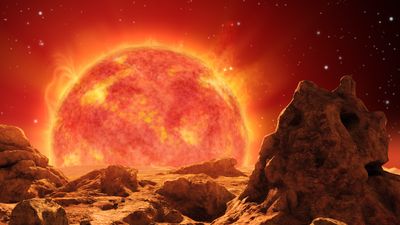


One day, many billions of years in the future, the Sun will no longer be the life-nourishing star it is now. Once it runs out of hydrogen to fuse at its core, it will swell into a red giant, with its plasma expanding to engulf the orbits of Mercury and Venus.
For decades, the general assumption was that Earth, too, would eventually be lost to this metamorphosis. A new study challenges that assumption, however, with detailed simulations of what might happen to the Sun once it has embarked on this next stage of life.
All hydrogen-fusing stars are in the main sequence, the longest and most stable stellar phase. After exhausting the hydrogen in their core, they move onto the red giant branch (or RGB). Low- and intermediate-mass stars like the Sun then move onto the asymptotic giant branch (AGB).
During the AGB phase, the core of the star is now mostly carbon and oxygen, surrounded by an envelope of fusing helium and a further envelope of fusing hydrogen. The other exterior layers of the star swell up massively and can easily be lost in the stellar wind, as they are only loosely held by gravity.
There are two competing factors that will shape the future of Earth and the inner solar system under this scenario. On one hand, the swelling of the Sun will cause tidal forces that pull the planets closer. On the other hand, as the Sun enlarges, it loses mass, reducing its gravitational pull and causing the planets' orbits to move farther out. The question is which of these will win out.
The team used the star L2 Puppis as a proxy for the future mass loss of the Sun. If it turns out to be a good proxy and if their assumption about the way tidal forces develop hold, then their results suggest Earth won't be engulfed by the Sun during its AGB phase after all.
This doesn’t mean it will be all sunshine and rainbows on our future planet, however. Actually, it will be all sunshine… even though Earth won't have been swallowed up by our expanding star, the swollen Sun will scorch its surface, making it uninhabitable.
The work shows just how uncertain our understanding of the evolution of the Sun is, and with it, how unsure we are about what will happen to our planet five billion years in the future.
A paper describing these simulations was published in the journal Astronomy & Astrophysics.