Space and Physics
 PUBLISHED
 1
1





Impact craters are pretty useful to astronomers attempting to learn about geology, or even for calculating the age of a planetary body − which is done by counting the number of craters and estimating the expected number of impacts over a certain timescale.
This is particularly useful the Moon and planets like Mercury, from which we only have one meteorite sample (maybe). Looking at the craters can help scientists figure out things like when geological events took place, and how much a planet or other body is shrinking.
But what happens when an object impacts a gas giant? How long do impact "craters" last when the object they are hitting is 90 percent hydrogen and helium? Well, in our years of observing the planets, we have captured several major impacts. And in the 1990s, astronomers captured a particularly large impact event, as a comet slammed into our Solar System's largest gas giant.
In 1992, Comet Shoemaker-Levy 9, which had been captured by Jupiter two or three decades earlier, passed a little too close to the giant planet. In fact, it passed closer than its Roche limit. This is the distance at which a smaller object can orbit a larger one without being torn apart by gravity.
The doomed comet wouldn't be discovered until the following year, slightly ahead of its final fall into Jupiter, when it was spotted by David Levy and Carolyn and Eugene M. Shoemaker. When they made their observation, the comet had already been shredded into over 20 pieces, and the fragments were circling Jupiter on a two-year orbit.
Astronomers figured out that the pieces of debris would soon collide with the gas giant. Even cooler, NASA's Galileo orbiter was on its way there, and it would be perfectly positioned to capture direct images as the fragments struck the atmosphere. Between July 16, 1994, and July 22, 1994, the probe did just this.
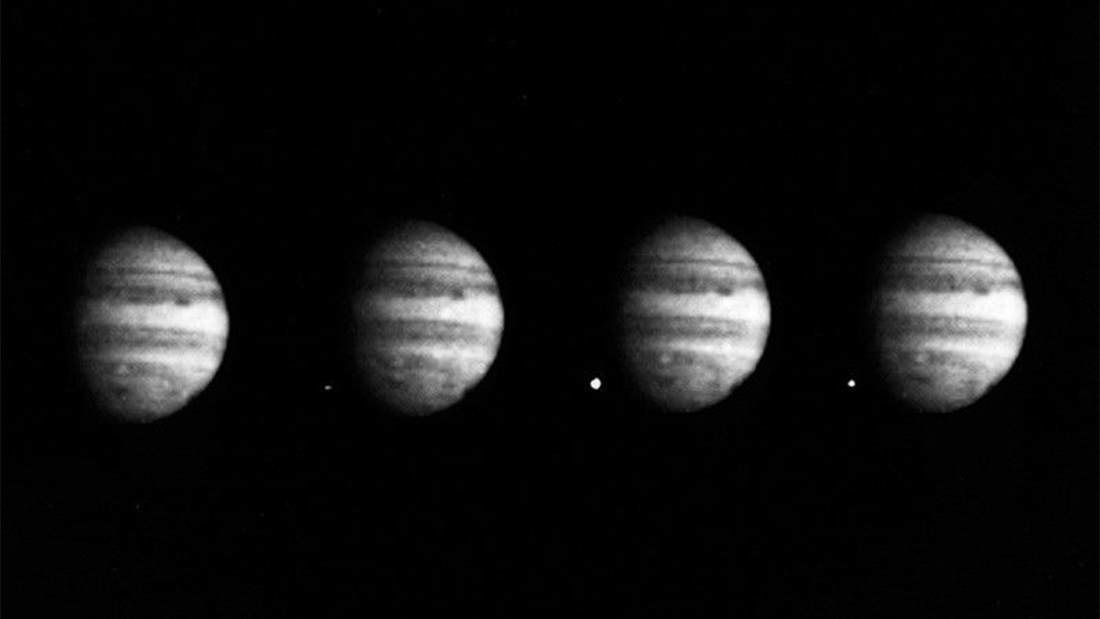
Humanity's telescopes, including the Hubble Space Telescope, also watched as the comet experienced the consequences of squaring up to a gas giant. As well as brief flashes as the fragments made impact, astronomers saw marks in Jupiter's upper atmosphere that would last for months after the collision.
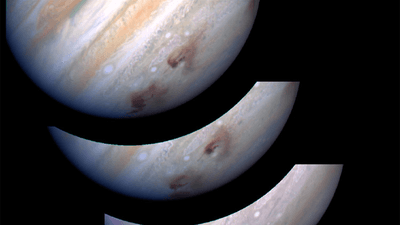
"The 'freight train' of fragments smashed into Jupiter with the force of 300 million atomic bombs. The fragments created huge plumes that were 1,200 to 1,900 miles (2,000 to 3,000 kilometers) high and heated the atmosphere to temperatures as hot as 53,000 to 71,000 degrees Fahrenheit (30,000 to 40,000 degrees Celsius). Shoemaker-Levy 9 left dark, ringed scars that were eventually erased by Jupiter's winds," NASA explains.
These impact scars were useful to scientists, just as impact craters are on rocky planets, though they were by no means as permanent.
"The collision also left dust floating on the top of Jupiter's clouds. By watching the dust spread across the planet, scientists were able to track high-altitude winds on Jupiter for the first time," says NASA. "And by comparing changes in the magnetosphere with changes in the atmosphere following the impact, scientists were able to study the relationship between them."
As well as marks that persisted for months, and chemical signatures that persisted over a year, the impact may have left Jupiter with a new ring.
“When SL9 [Shoemaker-Levy 9] broke apart, it surely generated a lot of small particles," Professor Mihály Horányi at the University of Colorado Boulder told IFLScience, following a 2024 study. "This happened inside Jupiter’s magnetosphere, where the dust gets electrically charged, and in addition to Jupiter’s gravity, electromagnetic forces move particles on orbits that remain tied to Jupiter. Subsequently, they lose energy and angular momentum and the dust particles settle into a ring around Jupiter.”
“The expected optical depth of this ring is very small, so probably remains hidden in telescopic observations,” added Horányi. “However, it could be possibly noticed by in situ dust detectors, like the SUDA instrument on its way to Jupiter onboard NASA’s [Europa] Clipper mission.”
We will have to wait until Europa Clipper arrives at Europa, the smallest of Jupiter's Galilean moons, in 2030, before this hypothesis can be tested. But it's possible that in Shoemaker-Levy 9 we saw our first comet bound to a planet, the first impact viewed from space, and the first impact to leave a ring around a planet. Not a bad end, for a comet.