Space and Physics
 PUBLISHED


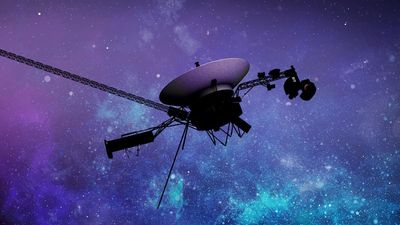


Voyager 1 continues to be a marvel of engineering. In August, it will have been traveling in space for 49 years. In November, it will be the first human-made object to be 1 light-day from us. Unfortunately, even at that incredible distance, aging catches up with us all.
The spacecraft is nuclear-powered: it uses a radioisotope thermoelectric generator. Decaying plutonium produces heat, and some of it is turned into electricity. Slowly but surely, there is less and less plutonium, so the spacecraft is getting less and less electricity and heat from its battery. In February, Voyager 1 was doing a routine roll maneuver and its power levels were seen dropping significantly.
Any additional drop in power could have triggered the spacecraft's undervoltage fault protection system. This leads to the shutdown of a variety of components to safeguard the probe. The team can then recover them. While this is designed to protect the spacecraft as much as possible, after almost 49 years and more than 25 billion kilometers (15.5 billion miles) from Earth, this is very risky.
The team decided to act fast and turn off the Low-Energy Charged Particles experiment, or LECP. This is an important loss for Voyager 1. The instrument has been operating almost nonstop since 1977, and it provided incredible insights when the probe moved into interstellar space, leaving behind the heliosphere – the region dominated by solar particles.
“While shutting down a science instrument is not anybody’s preference, it is the best option available,” Kareem Badaruddin, Voyager mission manager at JPL, said in a statement. “Voyager 1 still has two remaining operating science instruments – one that listens to plasma waves and one that measures magnetic fields. They are still working great, sending back data from a region of space no other human-made craft has ever explored. The team remains focused on keeping both Voyagers going for as long as possible.”
The team didn’t just shut down a random instrument. There is a list of priorities, and this instrument was the next one that would be shut down if the need arose. Both Voyager 1 and its twin Voyager 2 have the same suite of 10 instruments. Voyager 2's LECP was shut off in March 2025. Only three instruments remain operational on Voyager 1.
This sad but necessary development needed to happen for the longevity of the mission. The team has a plan – nicknamed the Big Bang – to turn off multiple things at once and replace them with low-powered approaches so that the spacecraft will continue to work for longer. It will first be attempted on Voyager 2, which is a bit closer to Earth and has a bit more power.
The first test might happen in just a few weeks, and if successful it will be attempted on Voyager 1, though no earlier than July. Usually, when an instrument is switched off, that’s it for it. In this case, there’s a chance that the LECP of Voyager 1 might come back online again.