Space and Physics
 PUBLISHED



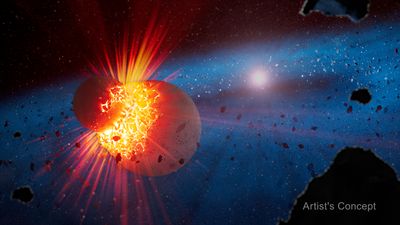


Years ago, the now defunct NASA Spitzer telescope spotted a handful of unusual debris disks around young stars. They are characterized by a large amount of warm dust covering regions as big as the inner solar system, and so were called extreme debris disks.
Observations with JWST and archival data from Spitzer have since expanded the catalog by several times. Now with 21 known systems, researchers are able to better understand what these systems are like. And it turns out they're chaotic and full of collisions.
“This is the first time we have gathered enough systems to truly understand this subclass that we call extreme debris disks,” lead author Kate Su at the Space Science Institute in Boulder, Colorado, said in a statement.
There are three things these extreme debris disks have in common. The first is that they have smaller dust grains than the standard protoplanetary disks from which most planetary systems are formed. The second, as mentioned earlier, is that there is a high concentration of warm dust. The third is irregular variation in their brightness.
All of this suggests there are collisions going on within these systems, grinding up the dust, keeping it warm, and making the whole system noisy.
The team was also able to learn more about the chemical makeup of these debris disks, estimating that about one-third of them are rich in silica, while the remaining two-thirds are silica-poor.
The first group then must be experiencing high-energy impacts between Mars-sized bodies, where a good chunk of those planets are vaporized. This happened only in systems younger than 300 million years.
The remaining group presumably has more modest collisions, but these would still be impressive, with moon-sized objects regularly hitting or grazing each other. These systems have a broader range of ages and larger changes in brightness.
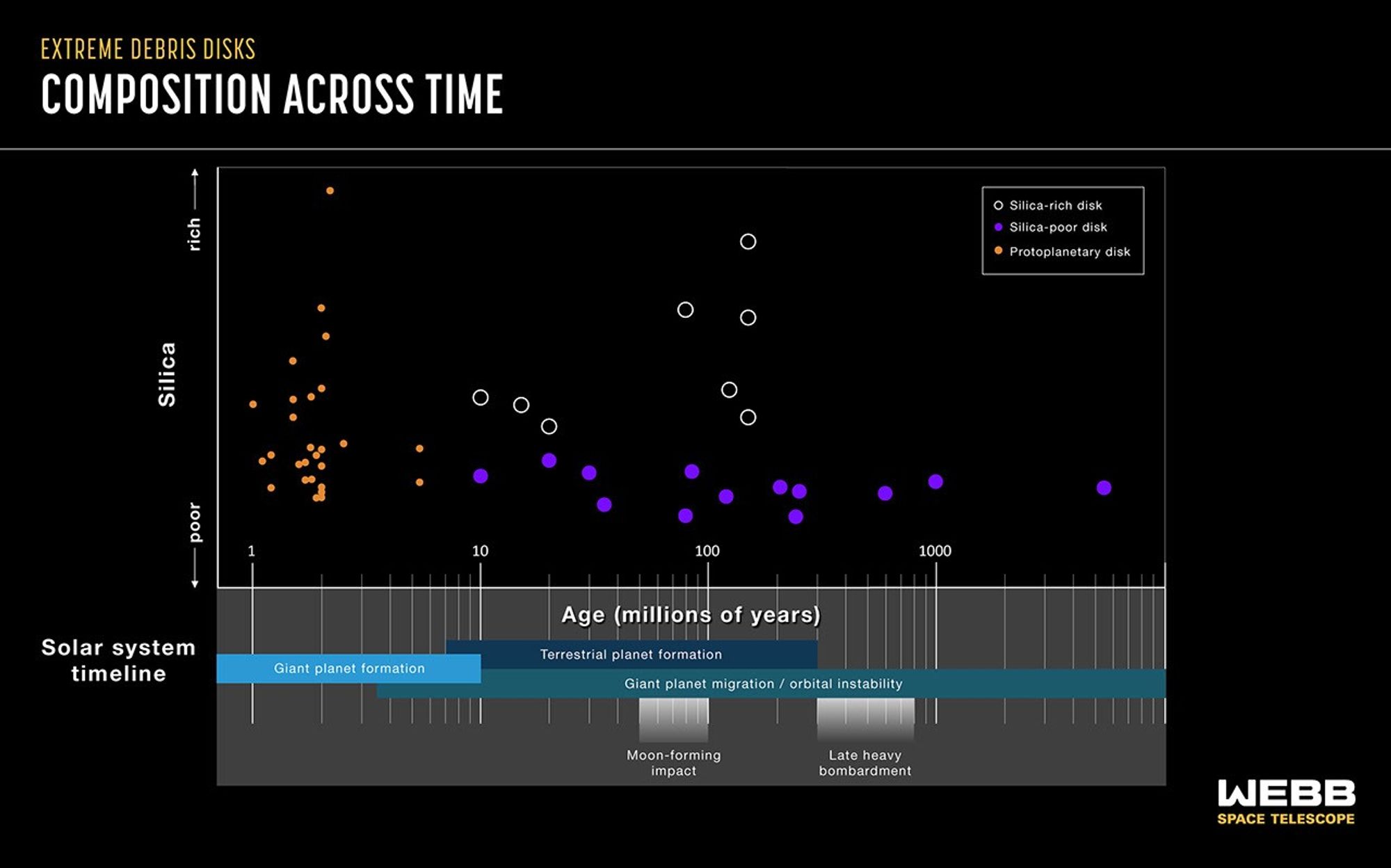
Our own solar system might have gone through one or both of these phases between the birth of the Sun and settling into its current arrangement. The Late Heavy Bombardment Hypothesis could reflect one of these phases, as might the collision that formed the Moon, when a Mars-sized object is proposed to have hit the early Earth.
“How rocky planets formed and giant planets evolved are part of the broader story of the solar system’s formation. It’s all one story,” added Su. “Our work on extreme debris disks helps us bring together the big picture of what we currently understand.”
Theory suggests these system should be more common, but observations place them as only 1 percent of all debris disks.
The findings were published in The Astrophysical Journal.