Space and Physics
 PUBLISHED


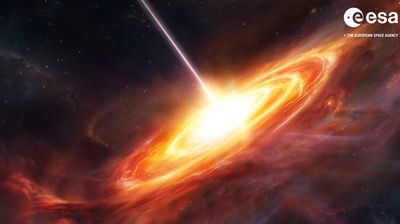


Quasars are the extremely active periods in a galaxy's life when its supermassive black hole is feeding. This process releases a gargantuan amount of energy, making the core of the galaxy shine incredibly brightly. So bright, the whole system might appear as a dot of light, hence the name quasi-stellar, or quasar. Using Euclid, astronomers report the discovery of 31 new quasars in the early universe, including the two earliest ever seen. They existed when the universe was just 5 percent of its current age.
The European Space Agency's Euclid space telescope has been nicknamed the "Dark Universe Hunter" because one of its goals is to collect insights into dark matter and dark energy, the still-hypothetical dominant components of the cosmos.
It does so by taking extremely high-precision views of galaxies and measuring their redshift, which is a measure of distance and motion due to the expansion of the universe.
Euclid combines both wide coverage and depth: it surveys a large area of the sky while maintaining excellent resolution. In just a few hours, it can observe an area 270 times larger than Hubble’s field of view.
Dr. Valeria Pettorino
Whenever a new telescope breaks a distance record for a type of object, those objects must be outliers. They are the brightest at that specific distance. The distant quasars known up to this point were exactly that. Euclid has added dimmer objects to that population and found bright ones that are even more distant.
Of the newly discovered quasar haul, 12 of these objects have a redshift of over 7, something never seen before, and their light comes from the first 770 million years of the universe. The two most distant ones, EUCL J172902.75+641018.1 and EUCL J125308.55+705432.3, are about 100 million years older.
“These early quasars date back to the universe's infancy,” Daming Yang of Leiden University in the Netherlands, lead author of the Euclid discovery paper, said in a statement.
"By finding and studying them, we can better understand how these enormous systems formed and grew so quickly – one of the greatest mysteries in astrophysics.”
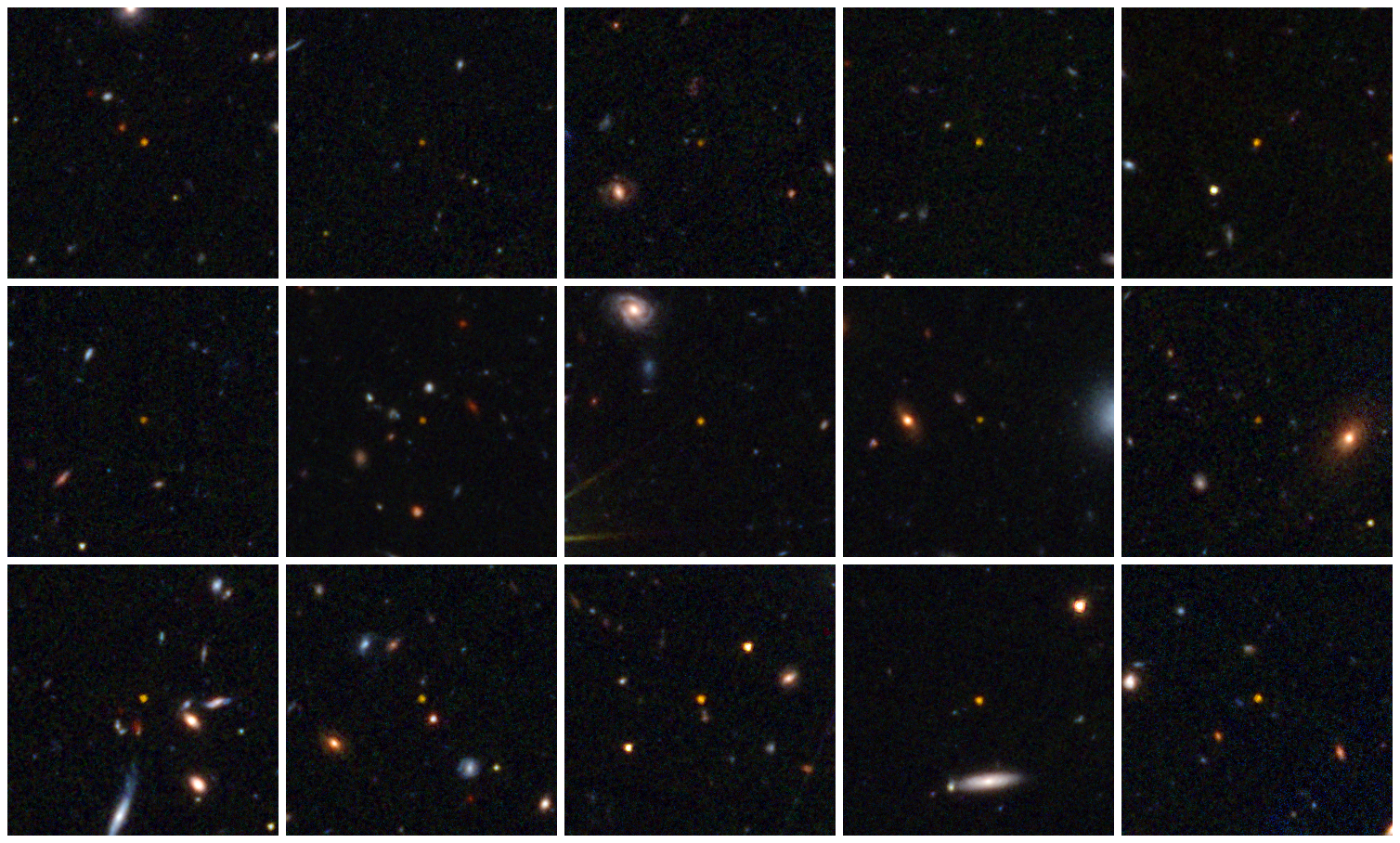
The findings have doubled the number of known quasars from the early universe. An incredible result for a device that is yet to publish its first data release (expected in 2027).
“Euclid is a true game-changer,” Yang continued. “Before, we could only find a handful of the very brightest ancient quasars, but Euclid lets us search far more efficiently across huge areas of sky to capture much fainter light. It’s a unique tool for quasar hunting.”
Euclid’s goal is to create the largest and most accurate map of the universe ever. It is designed to cover a huge amount of sky with high resolution, and even when it's not looking at the distant universe, it still delivers something exceptional. Only a few weeks ago, it produced an exquisite image of the center of the Milky Way that will help astronomers find a large number of new planets.
“Euclid combines both wide coverage and depth: it surveys a large area of the sky while maintaining excellent resolution. In just a few hours, it can observe an area 270 times larger than Hubble’s field of view, with comparable resolution," ESA Euclid Project Scientist Valeria Pettorino told IFLScience.
"This enables the detection of even rare objects with higher statistics and reveals not just the brightest quasars but also a population of fainter quasars that previous surveys missed.”
“In addition, Euclid observes not only in visible light but also in the near-infrared. Because of redshift, very distant quasars become extremely faint in the visible range, while remaining detectable in the near-infrared.”
The study is published in the journal Astronomy & Astrophysics.