Space and Physics
 PUBLISHED



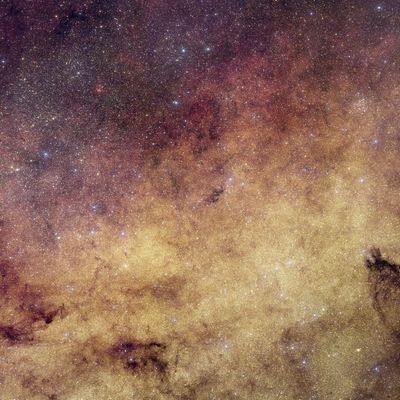


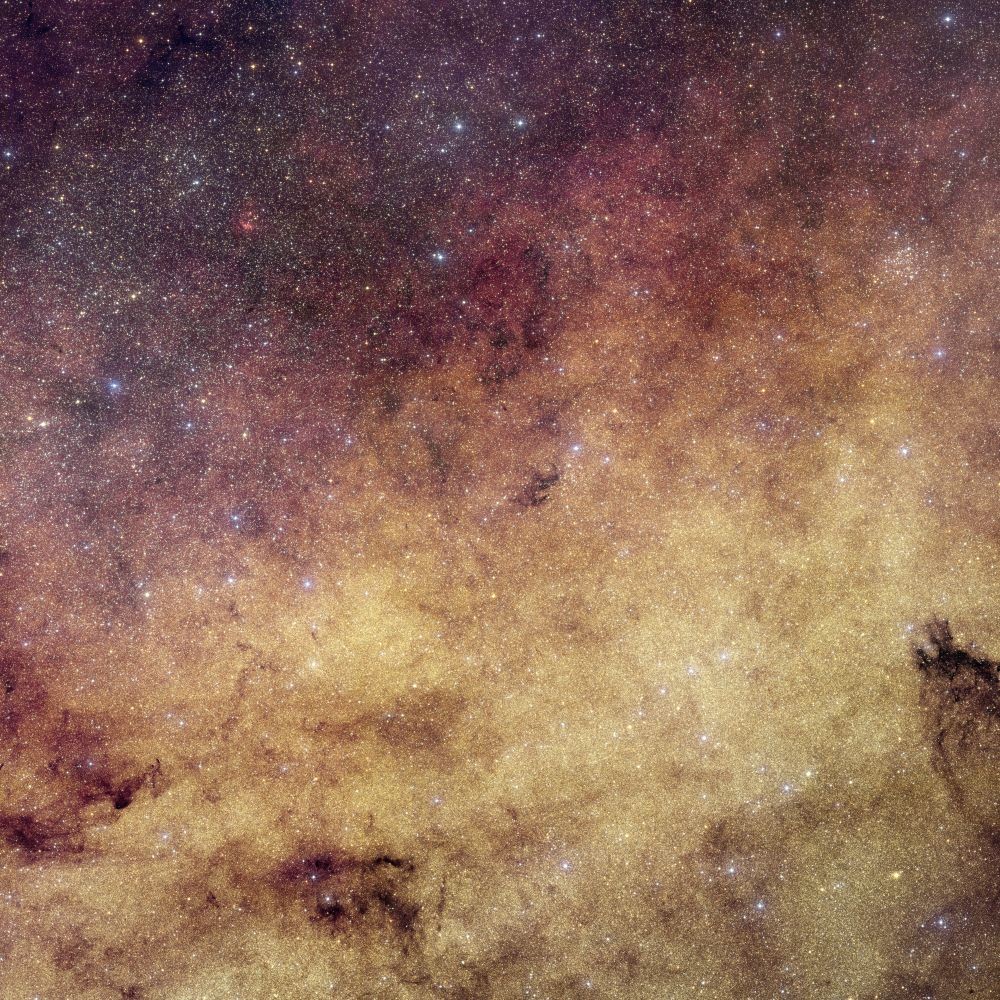
On March 23 2025, ESA's Euclid telescope spent 26 hours looking at something different from usual. The European Space Agency mission is designed to study billions of galaxies to understand what dark matter and dark energy are. This time, though, the focus was just a little bit of one galaxy: the very core of the Milky Way.
The enormous photo is a mosaic of nine "pointings" of the space telescope's visible light camera, each pointing covering an area of the sky slightly larger than the full Moon. The result is something beyond breathtaking.
Over 60 million stars feature in this photo, as well as nebulae and star clusters. The full image at the highest resolution can be seen here.
Euclid is designed for collecting a lot of light with sharpness, precision, and speed. The Keck Observatory, for example, would need 2,000 hours – compared to Euclid's 26 hours – to match this image. While the sharpness and sensitivity are similar to Hubble’s, Euclid can span an area 270 times larger than the veteran space telescope in just a few hours.
Pointing the telescope to look at the central region of the galaxy wasn't just because it’s pretty or because Euclid can. The research team will use this incredible image and the data behind it to discover and characterize planets. This is possible thanks to a technique known as microlensing.
Any object with mass warps spacetime. Galaxies, clusters, and black holes can create a strong gravitational lensing effect: space-time warps so much that it acts as a lens, magnifying the background.
Microlensing is a lot more modest. It occurs when small changes to the luminosity of a distant star are caused by a foreground star passing in front of it. What’s exciting is if there is a planet orbiting the foreground star.
In that case, the microlensing is slightly asymmetric, hinting at the presence of the planet as it moves around its host star. In other cases, it's even possible to have a free-floating planet without a star doing the microlensing.
“To catch microlensing, you need to observe parts of the sky that are crowded with stars, such as close to the centre of our galaxy,” Euclid member Jean-Philippe Beaulieu, from the Institut d’Astrophysique de Paris in France and the University of Tasmania in Australia, said in a statement.
“During the last twenty years, almost 300 exoplanets have been discovered using this technique, all with ground-based telescopes and all towards the centre of our galaxy. This image from Euclid includes 51 known planetary systems – and it will assist in studying many more that will be found.”
So, how many planets has Euclid discovered with this image? The answer is zero. The set of observations has not been used to discover planets just yet, they are simply a crucial reference for future work.
It takes about 20 days of continuous observations to catch foreground and background stars overlapping. Space telescopes, like the upcoming Nancy Grace Roman, and ground observatories will instead be looking at the center of the Milky Way to spot microlensing events using the Euclid data as a reference.
“In 24 hours, Euclid has already captured the stars involved in all the future microlensing events that the Roman space telescope will detect, but before the stars and planets involved have aligned,” explained Natalia Rektsini of the Institut d’Astrophysique de Paris in France, who led the release of Euclid’s galactic bulge survey data for the scientific community.
“This means that anyone who detects a microlensing event in the same region, for example with Roman, will be able from now on to use Euclid data as a time reference in the past and see how the stars looked before they overlapped,” Rektsini explains.
“Since Euclid can clearly separate individual stars, one can then measure how fast they move over time and use that information to confirm the existence of a planet and determine its mass. This would not be possible with data from one point in time.”
Euclid continues to be a game-changing instrument, a jewel in ESA’s crown of space missions. And we are yet to see its first data release, which is coming soon.