Space and Physics
 PUBLISHED



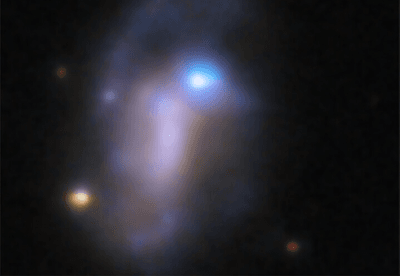


For only the second time, astronomers are confident they have witnessed the outburst of radiation at the start of a supernova. What came afterwards, however, was totally unexpected, and it may have broken our pre-existing categories of exploding stars.
One of astronomers’ great quests has been to witness the crucial first moments of a supernova. But the chance of a typical telescope looking in the right place at the right time is low, so for decades astronomers were left frustrated by what they had missed.
However, some modern X-ray telescopes now capture large areas of the sky at once, and in March 2026, one such detector, the Einstein Probe, caught a flash of X-rays from a galaxy 500 million light-years away.
Other telescopes quickly pivoted to observe the signal, which was later designated SN 2026gzf, allowing two teams to confirm the X-rays came from the "shock breakout" of the supernova explosion.
Modeling predicts these shock breakouts are caused when the explosion first tears through the surface of the doomed star, allowing the supernova’s light to illuminate the universe.
Shock breakouts are thought to carry an extraordinary amount of information about the final condition of the doomed star. However, the event happens so fast – hours at most and possibly just seconds – that only one definitive X-ray shock breakout has previously been observed, and that was 18 years ago.
It doesn’t help that the shock breakout occurs in relatively under-studied parts of the electromagnetic spectrum, near the border of X-rays and UV light.
Many Ways To Go Out With A Bang
When we find supernovae, we categorize them based on their spectra, and SN 2026gzf looks like a Type Ic with broad spectral lines.
The broad lines indicate material is expanding from the star immensely fast, usually associated with jets that travel at close to the speed of light.
It has been noticed that broad-lined Type Ic supernovae are the ones most likely to be accompanied by gamma ray bursts (GRBs), the most powerful energetic emissions in the universe.
Yet 2026gzf is an oddity. No GRB was seen, its explosion was fairly normal, and the shock breakout was the weakest that can still be considered a candidate for a broad-lined Type Ic supernova.
“SN 2026gzf looks remarkably similar to other energetic supernovae that have been previously linked to gamma-ray bursts. Yet multi-wavelength follow-up observations using the most sensitive facilities found no evidence for a relativistic jet or an afterglow, which are typically seen in those events,” said Professor Bendan O’Connor at Carnegie Mellon University in a statement.
“One possibility is that the jet was ‘choked,’ either by the surface of the star or by circumstellar material surrounding the star.” O’Connor led one of two teams that observed the explosion and came to similar conclusions about its unusual nature.
A Lucky Location
A stroke of luck has since allowed astronomers to learn much more. The explosion occurred within the recently operational Vera C. Rubin Observatory’s Deep Drilling Field (an expanded version of the famous Hubble Deep Field), which meant there were images of its host galaxy shortly before the big event.
Despite its location in a bright star-forming region, the team was still able to observe signs of activity in the giant star shortly before it went out in a blaze of glory. They were also able to regularly check on the supernova’s development without having to bid for time on another giant instrument.
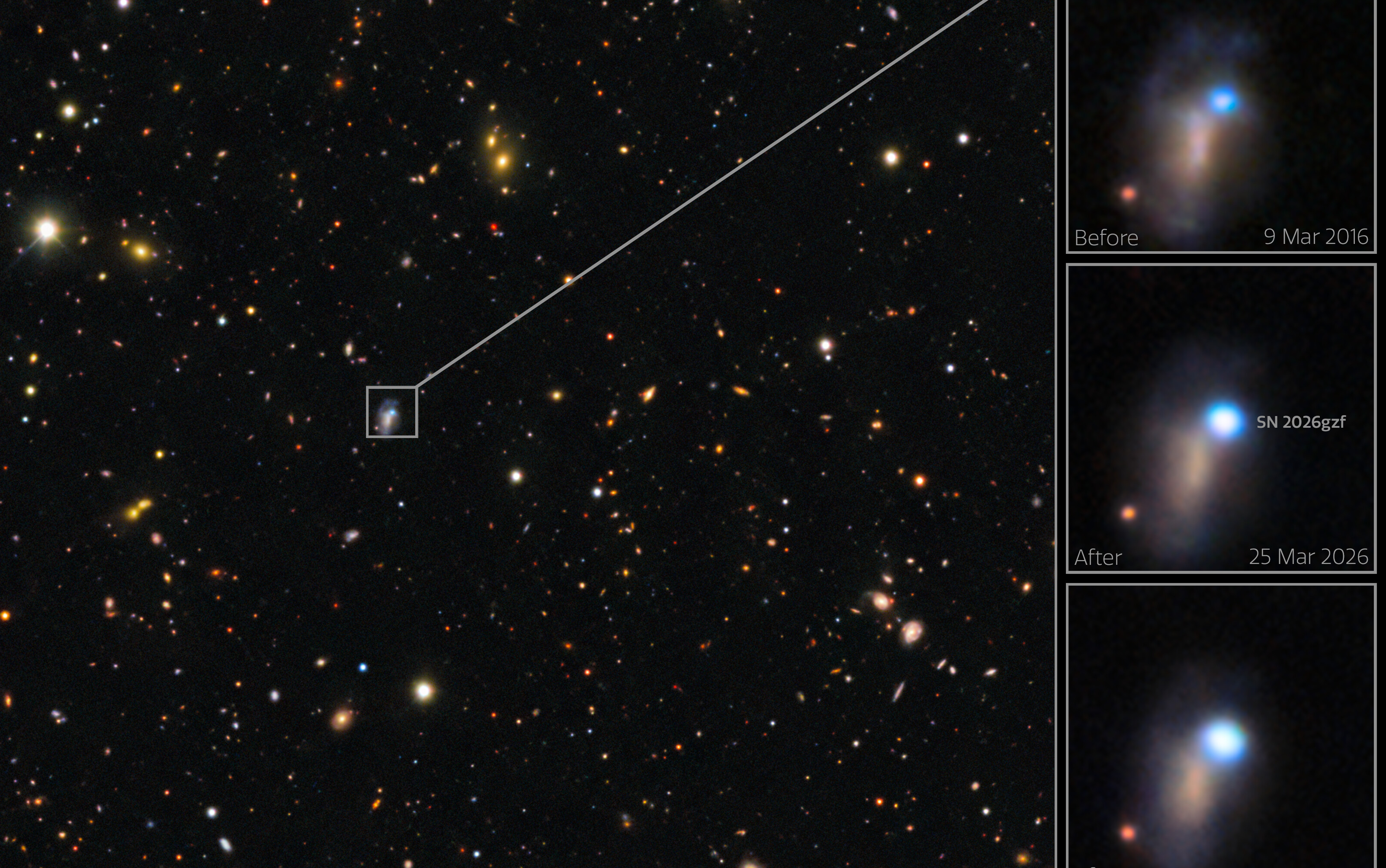
Those subsequent observations, along with others conducted up and down the electromagnetic spectrum, convinced the team that this is indeed a broad-line Type Ic, but if the jets exist, they continue to be undetectable. If a GRB had occurred, it would have been one of the closest we have ever seen.
Most significantly, the Rubin records reveal the progenitor as a Wolf-Rayet star, a kind of high-mass star known for its extreme stellar winds. As Wolf-Rayet stars frequently do, the progenitor threw off shells of material before it went boom.
Specifically, it shed all its unfused hydrogen and helium, creating a series of shells around it and leaving a doomed star composed of carbon, oxygen, and traces of heavier elements. Such shells fit a scenario in which the GRB was "choked," which is why we couldn't observe it.
Although the team thinks the choking scenario explains all the observations, it leaves plenty of questions about the mechanism, and why other supernovae of the same type don’t do the same thing.
“This is the first time we’ve mapped out the pre-explosion environment of a star that has been stripped of hydrogen and helium,” said Dr Gokul Srinivasaragavan at the University of Maryland. “Going forward, I’m excited to observe more shock breakout events in similar detail to test if all stripped stars have a similar ‘lifestyle’ prior to collapse and what, if any, differences we see.”
SN 2026gzf suggests GRBs aren't a universal feature of this type of supernova, and therefore stars with masses at least 20 times greater than the Sun have a previously unrecognized way in which they can die.
The study is open access in The Astrophysical Journal Letters.