Space and Physics
 PUBLISHED


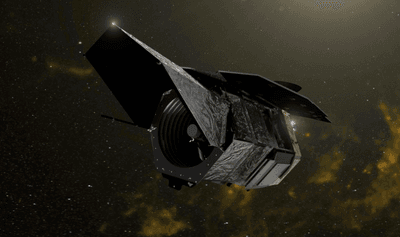


NASA's next great off-world observatory, the Nancy Grace Roman Space Telescope, is complete and ready to be taken to the skies. The observatory will fly into space in early September for a nominal mission of five years, and thanks to its incredible capabilities, is expected to provide new insights into exoplanets, black holes, and even the biggest open questions about the universe itself.
The observatory is named after Dr Nancy Grace Roman, who was NASA’s first Chief of Astronomy throughout the 1960s and 1970s. The work Roman conducted across her 50-year career has paved the way for many of the exploration missions that are now underway at space agencies worldwide. A particular contribution, though, is worth mentioning. She’s remembered as the "Mother of Hubble” for her relentless work to make the "most powerful space telescope" a reality.
The Roman observatory will be a worthy successor to the Hubble Space Telescope, even though it is late in its fourth decade of activity and continues to work. Roman has two cameras, each with a field of view 100 times larger than Hubble. This will allow Roman to see the bigger picture – quite literally – of the universe. In particular, the Roman observatory will contribute to our understanding of the accelerated expansion of the universe and facilitate the discovery of many new exoplanets, including those that are not orbiting any stars.
“Roman will investigate dark matter, dark energy, and the structure of the universe itself and accelerate the future discovery of potentially habitable planets outside our Solar System. Its surveying capabilities are over 1,000 times faster than Hubble's and can chart 200 times more sky in a single image. It would take Hubble 2,000 years to process what Roman can do in a year,” NASA administrator Jared Isaacman said during a press conference.
The Roman telescope has a 2.4-meter (7.9-foot) mirror, the same as Hubble, but it will provide an astounding amount of data about the universe compared to its predecessor. On Friday, April 24, Hubble will be 36. Hubble has so far delivered over 400 terabytes of data. Roman will send 1.4 terabytes every day. It will match Hubble’s three decades' worth of data in less than one year, and by the end of the nominal mission, it might have delivered 2,500 terabytes of new science and new insights.
“The Nancy Grace Roman Space Telescope is a sheer powerhouse. It is literally a speed machine. The speed at which we'll be scanning the sky, delivering vast amounts of data, and returning results will be at an unprecedented rate, never done before,” Dr Nicky Fox, associate administrator for NASA's Science Mission Directorate, added.
“With Roman’s construction complete, we are poised at the brink of unfathomable scientific discovery,” Julie McEnery, Roman’s senior project scientist at NASA Goddard, said in a statement. “In the mission’s first five years, it’s expected to unveil more than 100,000 distant worlds, hundreds of millions of stars, and billions of galaxies. We stand to learn a tremendous amount of new information about the universe very rapidly after Roman launches.”
The potential of this instrument is truly groundbreaking, both in the search for habitable worlds and in the current big uncertainty on the standard model of cosmology, even beyond the unknowns that are dark matter and dark energy. And who knows what else it will find?
“The most exciting science from Roman is going to be the things that we didn't expect, that we couldn't predict, but that will set the new deep questions for future missions to address," McEnery added in the press conference.
Roman is expected to launch in early September 2026 from NASA’s Kennedy Space Center.