Space and Physics





What you'll discover in this article
- Astronomers may have found the first known "exomoon", a natural satellite that orbits a planet or other object outside our Solar System.
- The International Astronomical Union, which defines cosmic objects, currently has no formal definition for moon.
- This discovery may push the IAU to adopt one, lead author Kevin Hoy tells IFLScience, as this is likely the first of many discoveries.
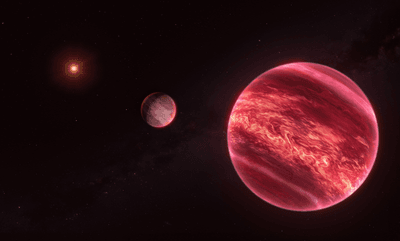
A brown dwarf is wobbling on its path around a star in a manner that indicates it has its own giant satellite. This represents the best evidence yet for a “three-tiered" stellar system; in other words, a star system other than our own that features a moon. The first known "exomoon", if you will.
With more than 6,000 exoplanets (planets orbiting stars besides the Sun) now discovered, some astronomers have turned their attention to finding exomoons, ie natural satellites that orbit those planets or other non-stellar objects.
Today, Kevin Hoy, a PhD student at Diego Portales University in Chile, and his colleagues have announced the clearest potential signal for one of these exomoons yet spotted. But the question of whether it actually counts as a "moon" could come down to a matter of definitions.
Not quite a star, not quite a planet
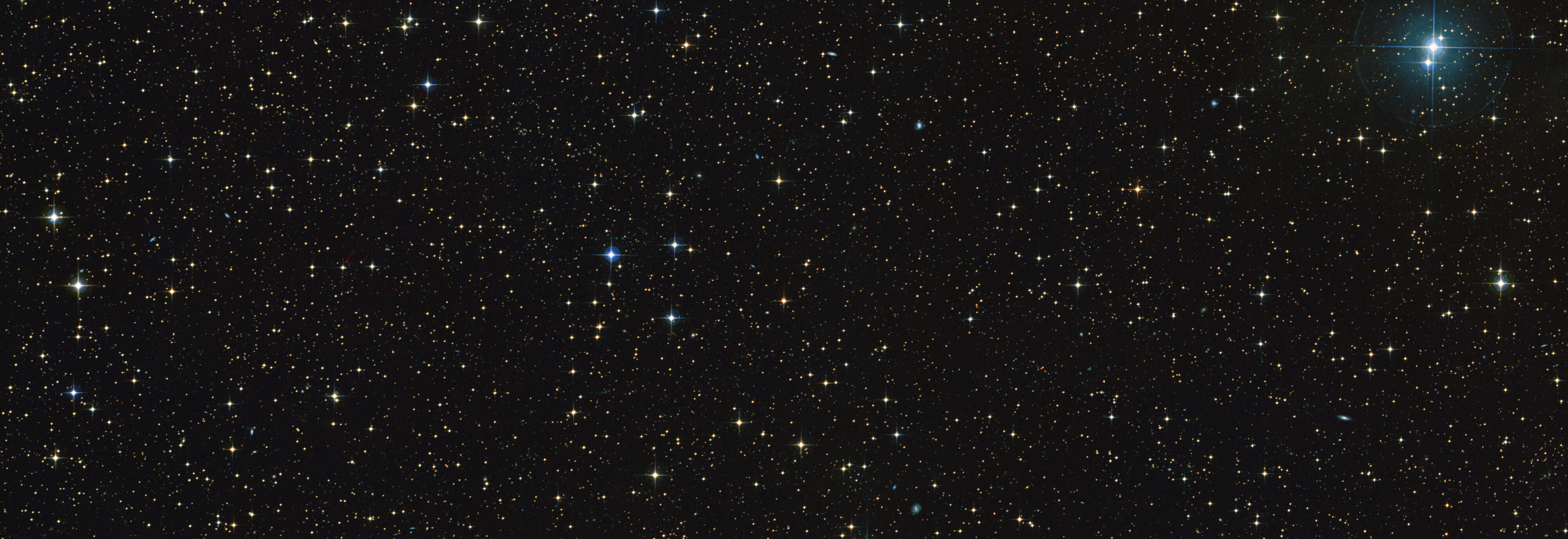
The findings involve the system CD-35 2722, which consists of a small M-type star orbited by CD-35 2722B, a brown dwarf, a category of objects that are a halfway house between stars and planets.
Stars have enough gravity to force hydrogen atoms to fuse in their core. Planets don’t, so they must get their heat from external sources or from energy left over from their formation and the decay of radioactive elements in their cores.
Brown dwarfs are massive enough to cause a special kind of hydrogen called deuterium to fuse, but they can't manage ordinary hydrogen. Since deuterium is relatively rare, they put out much less heat than even the coolest main sequence stars.
This particular brown dwarf has a highly elongated orbit, and careful tracking reveals it doesn't follow a smooth path. Something is almost certainly exerting an extra gravitational pull on it, causing the brown dwarf to travel in a spiral.
After considering several explanations, Hoy and his colleagues conclude that an object about 90 percent as massive as Jupiter in an orbit lasting 170 days around the brown dwarf fits the data almost perfectly. No alternative explanation they could model worked well at all.
Although the finding bears some resemblance to the potential exomoon HD 206893B I, which was tentatively announced last year, Hoy told IFLScience this detection is much clearer.
Even if we can dispense with doubts about the satellite’s existence, however, the question of what to call it remains. “This system is somewhat hard to define using Solar-System-based words like ‘planet’ and ‘moon’,” Hoy said in a statement.
The team is using the term "exosatellite" for the moment to avoid taking sides. “The exosatellite is clearly massive enough to be a planet, but it does not orbit a star, though it orbits an object that orbits a star," Hoy explained.
The IAU has no definition for 'moon' at all, and this discovery may push them towards adopting one, as this is the first of likely many similar discoveries in the coming years.
Kevin Hoy
"Being the third wheel in this system makes us want to call it a moon, even if it is nothing like the small, rocky moons we have in our system.”
“We have a clear delineation between the planets and the Sun in the Solar System, so defining things like moons is simple," said co-author Alice Zurlo, director of the Millennium Nucleus of Young Exoplanets and their Moons (YEMS).
"In the CD-35 2722 system, where we are blurring the lines between stars, planets, and moons, the whole thing becomes more complicated to describe.”
Is a brown dwarf sufficiently star-like that an object that orbits it should be considered a planet? Or are they more planetary in nature and therefore have satellites that should be considered moons?
In addition, does it matter if the brown dwarf – as in this case – orbits a true star, rather than floating alone in space, as many do? Does the nature, particularly the size, of the satellite also matter, or is the object being orbited the only thing that matters?
Alternatively, perhaps astronomers should refuse to squeeze brown dwarfs into the star/planet binary and acknowledge an in-between class of satellites with a new name – "ploons" or "manets," perhaps.
We created the category of “dwarf planets" for Pluto, Ceres, and others, and everyone’s been fine with that, haven’t they?
So far, only a handful of exoplanets have been observed directly. Most discoveries are based either on the dimming of their star as the planet blocks its light, or on the wobble induced by the planet's gravity.
The situation is likely to be similar for exomoons for a long time to come. Initial discoveries will be large enough to block a lot of their star’s light or massive enough for their gravity to strongly affect their brighter neighbors.
For now, there's no formal proceeding on how the object should be described, as far as I'm aware.
Kevin Hoy
Consequently, early finds will tend to be those most likely to create problems for existing definitions.
“For now, there's no formal proceeding on how the object should be described, as far as I'm aware," Hoy told IFLScience.
“The [International Astronomical Union (IAU)] would consider the object a planet, because their definition makes no reference to hierarchy further than the direct host, and brown dwarfs qualify as hosts for planets. However, the IAU has no definition for 'moon' at all, and this discovery may push them towards adopting one, as this is the first of likely many similar discoveries in the coming years.”
CD-35 2722B’s companion was found using the same technique as most early exoplanets: radial velocity. Subtle changes to the brown dwarf’s spectrum collected by the Very Large Telescope indicated it was moving towards and away from us on a 170-day cycle.
Hoy expressed confidence in the finding because there is a 600 meters per second difference in CD-35 2722B’s movement relative to us, with error bars of just 50 m/s or so.
Reporting of HD 206893B I, on the other hand, relied on astrometry, the much more challenging task of measuring the brown dwarf’s position in the sky precisely.
“We also have more data points and were able to confirm the detection by predicting the future [radial velocity] points, measuring them, and finding that the projection and the true values were in agreement,” Hoy told IFLScience.
Earlier reports of exomoons used dips in stellar brightness and have since met with considerable doubts.
An eccentric character
The signal is clear, but a CD-35 2722B satellite comes as something of a surprise, because the brown dwarf’s orbit is so elliptical.
“Highly eccentric objects would have trouble keeping their moons, as that introduces a lot of chaos to the system,” Hoy told IFLScience, having called the system “super weird." He attributes the stability of the arrangement to CD-35 2722B’s long orbital period, which never brings the brown dwarf and star all that close together.
That distance between the system’s components also gives us a much clearer view of what is going on than in other systems. Combined with the fact that CD-35 2722 is a modest 71 light-years away, these factors allowed the discovery and enhance the prospects for future research.
Although the brown dwarf puts out little light compared with a star, Hoy noted to IFLScience: “Brown dwarfs could have very temporary regions around them where the equilibrium temperature of a hypothetical planet would allow for liquid water. This zone would be very temporary, however, because brown dwarfs cool off rather quickly.”
In this case, however, most of the satellite’s heat is probably still internal, released as it coalesced.
The study is published in Nature.