Space and Physics



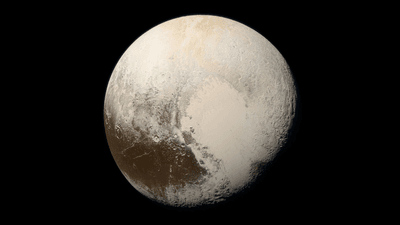


Space billionaire and NASA administrator Jared Isaacman has once again ignited the discussion on the planetary status of Pluto. This debate has been going on for 20 years, or more than one-fifth of how long humanity has known that Pluto has existed.
Pluto was discovered by Kansas-born Clyde W. Tombaugh at Lowell Observatory in Flagstaff, Arizona, on February 18, 1930. It will be the first of the so-called Trans-Neptunian objects (TNOs), objects that orbit beyond Neptune (although Pluto doesn’t all the time, more on this later).
In the early 2000s, the discovery of other large TNOs brought forth the discussion of whether the planetary class should be expanded. Was Sedna a planet? How about Haumea? They were smaller than Pluto, so they kept getting kicked down the road. And then astronomers Mike Brown, Chad Trujillo, and David Rabinowitz found Eris on January 5, 2005.
We know now that Eris is slightly smaller than Pluto but more massive; at the time, it looked bigger on all parameters. If Pluto were a planet, Eris would have to be as well. The International Astronomical Union (IAU) – the internationally recognized authority for naming celestial bodies and defining astronomical terms since 1919 – approved a new definition of a planet in 2006, classifying Pluto, Eris, and other objects as "dwarf planets". Two decades later, some Americans are still not willing to let it go.
The Latest Polemic
“I 100% support President Trump making Pluto great again,” Isaacman told The Daily Mail in a new interview. “I think we owe it to everyone from Kansas and all their great contributions to astronomy and aerospace to rightfully restore that discovery to a planet.”
Isaacman has had a turbulent relationship with President Trump. He was the original candidate for the NASA administrator role, but was pulled off that list after Trump’s public feud with Elon Musk last year because Isaacman was seen as an ally of Musk. He was then put forward again in November, this time getting the job.
He has since then been a champion of Trump. In a recent press conference to discuss the changes in the Artemis Program, Isaacman stressed the Trump administration’s support for NASA – a claim at odds with the administration's attempts last year to implement devastating cuts to the space agency, with the potential loss of many missions, which was only stopped by Congress.
However, Isaacman is not the only one under the impression Trump has the power to redefine space objects. Last year, William Shatner tried to get Elon Musk involved, tweeting, “We should ask Elon to get the President to sign one of those Executive thingies to make Pluto a planet again,” to which Musk replied he'd support that. Even Republican members of Congress have asked the President to "Make Pluto Planetary Again."
This is certainly not the first example of what some have called American jingoism when it comes to space (there was a recent claim that the US owned the Moon. Here's why it really doesn't). Still, the President of the United States has no authority to claim that Pluto is a planet.
Ceres Was There First!
Pluto is not even the first time object that was called a planet before having its “status” changed. The discovery of Ceres, the largest body in the Asteroid Belt, in 1801 was announced as the discovery of a new planet. The controversy of whether it was a planet started the moment Pallas – the third-largest asteroid in the Solar System – was discovered just a year later, on a similar orbit.
The discussion continued for decades. It was only by the 1950s that asteroids were no longer in the planet category. Ceres was defined as a dwarf planet in 2006, while Pallas is thought to be a remnant protoplanet.
Why Is Pluto Not A Planet?
The International Astronomical Union redefined the planet in 2006 to differentiate planets from the growing number of Kuiper Belt objects being identified. The definition of a planet is far from perfect, and there are proposals to make it better. Still, it is often mischaracterized. According to the IAU, a planet is a celestial body that:
- is in orbit around the Sun,
- has sufficient mass to assume hydrostatic equilibrium (a nearly round shape)
- has "cleared the neighborhood" around its orbit.
Pluto fails at number three. By clearing the neighborhood, astronomers intend that the object in question is the main gravitational body in its orbit. This is sometimes misunderstood to mean the planet is the only thing in its orbit, everything else has been swept away, but this is not the case. This is sometimes used in the Pluto argument.
For example, former NASA Administrator during Trump's first term, Jim Bridenstine, said in 2019: “Some people have argued that in order to be a planet, you need to clear your orbit around the Sun. [W]hat we now know is that if that’s the definition that we’re gonna use, you could really undercut all the planets.”
The actual crucial aspect is being the most important gravitational body in its orbit, so the large moons, which are round and go around the Sun with their planets, do not fall within the definition. Pluto is not the largest gravitational body in its orbit because its orbit crosses the orbit of Neptune.
Have a couple of fun facts about Pluto while we're here: None of Pluto's five moons actually orbit the dwarf planet and it still hasn't completed one orbit of the Sun yet since it was discovered in 1930. It will finally do that on March 23, 2178.
Scientific definitions are always fraught with limitations, complications, and even biases. A better definition of what a planet is may be put forward and will be debated and voted upon by the IAU, which is, importantly, an international non-governmental organization, so it operates independently of any country or government's influence. A new definition may be agreed upon, and it may once again make some people very angry. What is certain, however, is that planets are not defined by executive orders.