Space and Physics
 PUBLISHED
 3
3


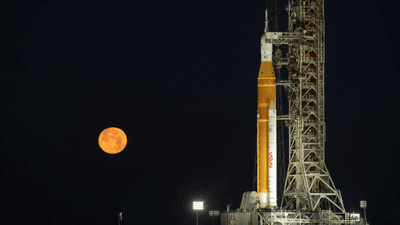


NASA has just given an update on the status of Artemis II and the Artemis program in general. NASA administrator Jared Isaacman has announced that the whole program is getting a focus shift. Instead of launching several years apart, the plan will be to launch the Artemis missions with a cadence of 10 months.
Artemis III will launch next year, and it will no longer land on the Moon. It will meet either or both the SpaceX Starship or Blue Origin's Blue Moon, the two possible lunar landers, in low-Earth orbit where mission-critical tests will be carried out, including of the new extravehicular activity spacesuits.
All of that going well, we will then see the Moon landing just months later, ideally with two launches in just one year. According to the proposal, Artemis IV and Artemis V will both attempt launch within 2028. However, there are many uncertainties in the lunar landers as they are yet to be fully tested – not just on the Moon, but even in space.
Isaacman avoided answering what the future holds for the Lunar Gateway, the space station that will orbit the Moon. The European Space Agency, NASA's partner in the Artemis Program, declared that they will continue to focus on it back in November 2025.
Before getting to the future of the Artemis program, Artemis II needs to fly. Acting Associate Administrator Lori Glaze confirmed that the NASA team is working hard to fix the issues, and the goal is still to launch the rocket during the April launch window. The dates are April 1, 3, 4, 5, and 6.
What has happened to Artemis II so far?
The rocket, the most powerful NASA has ever built, was rolled from the Vehicle Assembly Building (VAB) towards the launch pad in January, ahead of the first wet dress rehearsal. This is where Artemis II was fueled up, and the team acted out almost all phases of launch, but not the launch itself. It took place on February 2.
The goal was then to launch a few days later, but during this rehearsal, there were several fueling issues as well as a loose valve. Launch was pushed to at least March, and a second wet dress rehearsal took place on February 19.
The second rehearsal was a great success, having fixed all the issues that had appeared in the first one. The data was so good at first that the four astronauts of the crew – NASA’s Reid Wiseman, Victor Glover, and Christina Koch, and Canadian Space Agency’s Jeremy Hansen – went into quarantine on February 20. A few hours later, in the early morning of February 21, the team observed an interruption in the flow of helium in the upper stage engine. This is used to keep the correct environmental conditions in that portion of the rocket, which raised some alarms.
Artemis I also had a helium-related delay, so the team also reviewed the data from the previous mission, which was uncrewed, and made the decision to bring the whole rocket back to the VAB for a fix. The four astronauts left quarantine on the night of February 21.
Artemis II is the first crewed mission of the Artemis Program. It is a 10-day mission around the Moon, and will see the four astronauts traveling farther and faster than any human before... and in a spacecraft that's smaller than you might expect! The four crewmembers will see areas of the far side of the Moon that no human has seen before, and help massively with the future strategy of a human return to the surface of the Moon.