Space and Physics
 PUBLISHED
 6
6



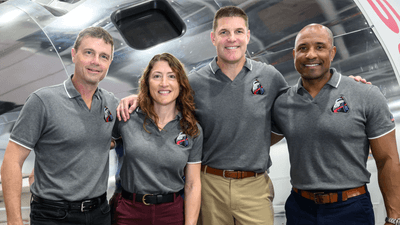


The countdown for Artemis II is on. The Space Launch System and the Orion capsule are being tested on the launchpad, and if all goes well, it will launch as soon as next week. The four-strong crew is already in quarantine, which is usually around 14 days before liftoff. These are the first humans to go back to the Moon since 1972 – and they're going to be breaking a whole bunch of new records.
NASA astronauts Reid Wiseman, Victor Glover, and Christina Koch, along with Canadian Space Agency astronaut Jeremy Hansen, have been in the health stabilization program, which limits their possible exposure so they do not pick up any illnesses ahead of the 10-day journey into space, since late Friday, January 23.
The mission itself is one of the most exciting in decades, taking humans back into deep space and beyond the Moon for the first time in over 50 years. The mission is crucial to the next step in the Artemis program, a return to the surface of the Moon, which will be the focus of Artemis III.
Artemis II will be fundamental to studying the human body in a deep space environment with modern monitoring technologies. Things have changed a lot since the Apollo era.
The farthest humans in space
The crew is expected to break the 55-year-old human spaceflight distance record for the farthest into space any human has gone before, currently held by Apollo 13. Why the conditional? The reason to be cautious is that we do not know when they are launching – the launch window opens on February 6, but weather will dictate if it launches that day – so we do not know when they will go around the Moon. The distance between the Earth and the Moon varies significantly, though they will be catching our natural satellite when it is at its most distant from us, a moment called the apogee.
In February, the apogee is happening on the 10th, and the Moon will be 404,576 kilometers (251,392 miles) away. The Apollo 13 crew reached 400,171 kilometers (248,655 miles) from Earth, and the Artemis II crew will be flying 6,513 kilometers (4,047 miles) beyond the Moon, which should place them comfortably beyond the Apollo 13 record. Glover and Koch will break a couple of records each, regardless, including the farthest a woman and a person of color has traveled in space and the first woman and person of color to go to the Moon.
Parts of the Moon humans have never directly seen
Previous missions to the Moon were launched so that landing sites would be lit by morning sunlight, allowing for greater warmth on the surface. This, however, meant that large portions of the far side, particularly, were shrouded in darkness and the Apollo astronauts never got to see them with the naked eye.
However, if they launch in February, the Moon will be getting close to its New Moon phase, meaning the near side is mostly in the night, and the far side will be well illuminated. This will allow the four astronauts to see and study areas of the Moon that no human has previously seen directly.
The fastest humans in space
On the return home, Artemis II should also set a record for the fastest humans have ever traveled in space by coming back to Earth at around 40,000 kilometers per hour (25,000 miles per hour).
The Orion spacecraft will hit Earth's atmosphere at this speed, which will exceed the record set by Apollo 10 in 1969 of 39,897 km/h (24,791 mph).
They hope to beforgotten
Wiseman, the commander of Artemis II, has said he hopes that they will be forgotten, as the next Artemis mission will bring humans back to the Moon for good. When that will be is unclear as yet. Artemis III will likely shift from a tentative schedule of next year to at least 2028, if not further down the line. Maybe Artemis II will be forgotten in the long run, but for now we will celebrate this record-making adventure!