


 Space and Physics
 PUBLISHED


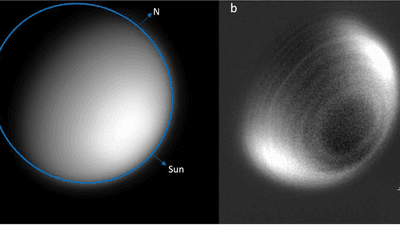


Astronomers looking through old and forgotten observations have found evidence of bizarre and beautiful planet-wide rings within Venus's atmosphere.
Way back in 2010, astronomers at the William Herschel Telescope in the Canary Islands were observing the skies, waiting for the Sun to set so that they could get a good look at the disks of dust surrounding young stars.
During the wait, the team captured the planet Venus in 36 minutes' worth of observations. Given that this was not the target of their observations, however, this data was archived and pretty much forgotten for over a decade.
This turned out to be a shame, after reanalysis of the data by researchers from the Netherlands found evidence for planet-wide rings within Venus's atmosphere.
Looking at the telescope's ExPo instrument, which measures polarized light and filters out unpolarized light, the team was able to investigate features within Venus's atmosphere. As light scatters on dust and gas, say in Venus's atmosphere, it becomes linearly polarized, helping astronomers to get a better understanding of the weather on a planet.
Here, they may have hit the jackpot.
"We report observations of faint (10−6), concentric, planet-wide rings in the polarized flux of sunlight that is reflected by Venus," the team write in their paper.
"The rings appear to be centered slightly downwind of the subsolar point, are visible in different filters across the visible, and are not obvious in the simultaneous total flux observations [or the total amount of light received from Venus, without separating out polarized light]."
The team falls short of calling this a detection of a new atmospheric phenomenon on Venus due to limits in the number of observations which were taken.
After the planet was serendipitously imaged, the ExPo instrument was dismantled, making these observations the only ones we have of the (potential) phenomenon. After the team found them, they spent several years trying to prove that they weren't really there at all.
"As these rings have not been observed before, we first suspected them to be due to an instrumental effect, in particular because they appear to be roughly concentric around the brightest region on Venus’s disk," the team explains in their paper, adding that they investigated plausible ways in which this effect could have an Earth-based explanation, but to no avail.
"We have not been able to identify an instrumental effect that would leave rings in the images taken in the Hα, Hα continuum, and Na filters and not in the other filters," they added.
"Nor can we identify a plausible mechanism by which filter-induced polarization alone, including in the narrowband filters, would produce the observed large-scale, spatially coherent ring pattern centered near the subsolar point on Venus’s disk."
If confirmed, this would not be the only time that planet-wide waves have been observed on Venus, lending the detection further plausibility. In 2015, the Japan Aerospace Exploration Agency (JAXA)'s Akatsuki orbiter identified a wave that stretched around 9,650 kilometers (6,000 miles), nearly from pole to pole.
Similarly, large gravity waves have tentatively been identified by instruments on the Pioneer Venus orbiter. In this case, planet-wide gravity waves altering the gas density of the atmosphere were suspected too, though this could not be confirmed at the time. The team suspects that gravity waves is what we are looking at here, too.
"Our numerical simulations show that both the flux and the degree of linear polarization across the disk are mostly determined by the characteristics of the cloud layer, but that changing the density of the carbon–dioxide gas above the clouds by 5% - 10% will give rise to a change of the polarization within ExPo’s sensitivity, while there would be no detectable change in Venus’ brightness," lead author and atmospheric physicist Gourav Mahapatra, from Delft University in the Netherlands, explained in his doctoral thesis.
"Such density waves could be triggered by the strong irradiation of the sub–solar region. Their spread across the planet seems to follow the known sub–solar to anti–solar flow."
If confirmed, the team suspects that the planet-wide waves may help explain Venus's super-rotating atmosphere. Whilst Venus's itself takes 243 Earth days to rotate on its axis, the atmosphere zips round in just four Earth days. But before that, we will need further observations of the planet, to find more evidence for or against this candidate detection of a potentially new atmospheric phenomenon.
The study is published in The Planetary Science Journal.


