Space and Physics
 PUBLISHED


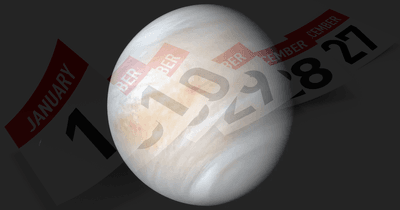


What day is it? What year is it? Unless, you are a time traveler with a broken time machine, those questions are pretty straightforward on Earth. Sure, not every culture might agree on the actual year or the day, but a day is 24 hours and a year is 365 days (with an extra day every four years). Not all the planets of the Solar System are that straightforward.
If we were on Venus, things would be different. First, we are imagining a Venus where the thick atmosphere doesn’t crush us, its lead-melting temperature doesn’t broil us, and the sulfuric acid rain is not falling on us. Even on our survivable Venus, the planet is still odd.
Venus goes around the Sun in 225 days; that is its revolution around the Sun, or one "year". But Venus orbits around its axis extremely slowly, in about 243 days. This is the sidereal day; if we were on the planet and the thick clouds were not there, we would see the same star right overhead every 243 days, so longer than its actual year.
Measuring that was not easy. The atmosphere of Venus is rich in the aforementioned clouds and very thick, producing incredible pressure. The atmosphere itself moves fast around the planet, completing a rotation in just four Earth days. This superrotation, combined with its size, actually tugs at the planet, changing the length of the day by several minutes.
It took 15 years for scientists to measure exactly how fast Venus is rotating and thus be able to work out how long a day is. In the end, they had to be truly creative and decided to turn Venus into a disco ball. They sent radio waves from a telescope at the planet. This type of light can penetrate the clouds and hit the surface. The slowly rotating surface shifted the radio waves while reflecting them, and once detected from Earth, researchers worked out the rotational speed of the planet and thus the length of its day.
However, that is only one type of day on the planet, but there is a second one. Earth’s sidereal day is 23 hours and 56 minutes. It’s its solar day, which is 24 hours. The solar day is how long it takes for the Sun to appear right on top of the same location every day, and as the planet goes around that very Sun, it’s the time of a rotation on the planet’s axis plus a little bit more.
For Mars, the difference is just a couple of minutes. In the case of Venus, it's a lot more. While Earth spins in the same direction as its orbit around the Sun, Venus spins in the opposite direction. This creates a situation where the sidereal day is wildly different. If we count a day from the Sun being overhead to the Sun being overhead again, then the day on Venus would last 117 Earth days.
Venus is a deadly, hellish world, and turns out not to be a good place if you like well-organized timekeeping.