Space and Physics
 PUBLISHED



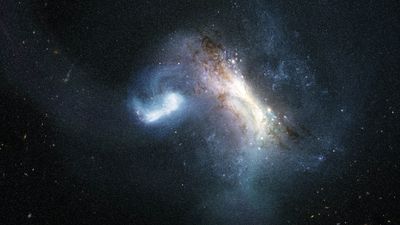


Our galaxy, the Milky Way, isn't exactly self-made. Sure, it gathered much of its current bulk on its own, but it also grew by gobbling up smaller galaxies that had the misfortune of getting a bit too close. Several of these events have been discovered already, and now astronomers report the earliest yet.
The most recent massive merger in the Milky Way’s history happened six billion years ago and continues to today. That was the collision with the Sagittarius dwarf galaxy, a ribbon of stars – the Sagittarius stream – that is currently wrapped around the Milky Way as evidence of that ongoing interaction.
Before that, there was the Gaia-Sausage-Enceladus merger, about 10 billion years ago. That merger was so powerful it affected the disk of the Milky Way, perhaps even flipping it more than 90 degrees. There were other smaller mergers between and before these two, and a new one has just been discovered.
A team of researchers used the Hubble space telescope to measure the properties of globular clusters, spherical collections of tens of thousands to a few million stars. Combined with the most accurate map of the Milky Way from the Gaia observatory, the team was able to work out that some of these globular clusters didn't originally belong to the Milky Way.
“Thanks to the high resolution and depth of Hubble imaging, we could measure the age and the metal content of these clusters with unprecedented precision,” Chiara Zerbinati at the University of Bologna, Italy, said in a statement.
“Coupled with measurements from Gaia, this made it possible to distinguish a population of globular clusters that are different from the others. These are the clusters that were born in [another galaxy], and they tell us when that galaxy was devoured by ours, and how massive it was.”
The team estimated that this galaxy weighed the same as around 500 million suns, which is a small fraction of today’s Milky Way’s mass but was a lot more significant earlier on. This is about 5 percent of the Large Magellanic Cloud, the biggest satellite galaxy currently orbiting the Milky Way.
“Our home is the Milky Way galaxy, but we do not know how our house was built,” added Davide Massari, lead author from the Astrophysics and Space Science Observatory of Bologna. “In this paper we discover where the first significant batch of bricks came from: a dwarf galaxy that we call LKH.”
Just like the Gaia-Sausage-Enceladus, this new ancient galaxy has a composed name. LKH stands for Low-energy-Kraken-Heracles, after three earlier research papers that suggested such a merger might have taken place.
“Some past studies have argued that the earliest phases of our galaxy’s evolution were defined by stars born only in our galaxy,” says Massari. “Here, we have shown that stars born in external galaxies also need to be considered.”
The researchers will continue to study globular clusters. The observations will hopefully probe the earliest, formative years for the Milky Way.
“Hubble is observing globular clusters that have never been studied before, and this will help us characterize the merger events that are far back in time in the Milky Way galaxy’s history,” said Fernando Aguado-Agelet at the University of Vigo and the University of La Laguna in Spain.
A paper describing the results was published in Nature Astronomy.