Space and Physics
 PUBLISHED


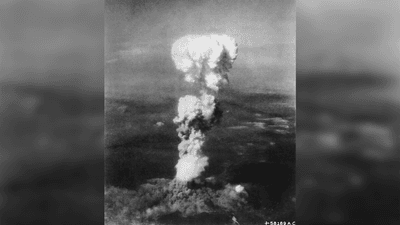


A metallic alloy found in the sands of Hiroshima Bay has never been seen before. The material is a product of metals vaporized by the heat of the atomic bomb dropped on the city, condensing together in ways that have never been seen before.
Geologists identify the sites of past asteroid impacts partially by the materials formed from the energy released in the impacts. Until recently, this was the only way such substances could be formed, at least on Earth, but today nuclear explosions can do similar things, creating completely new materials.
Earlier this year, a crystal unknown to science found at the site of the first nuclear detonation test – the Manhattan Project's Trinity test – was described to IFLScience by finder Professor Luca Bindi of the University of Florence as “Far beyond the limits of conventional synthesis.”
Now Bindi and colleagues have discovered another new substance forged in the giant accidental laboratory that was the Hiroshima atomic bombing.
On August 6, 1945, the "Little Boy" atomic bomb was dropped on Hiroshima, Japan, delivering the equivalent of around 12.5 kilotons of TNT. This was the first atomic bomb ever used as a weapon of war and its effect was devastating: 5 square miles (13 square kilometers) of the city were reduced to ashes and 120,000 people were killed in the first four days following the explosion.
Debris from the Hiroshima explosion is known as hiroshimaites, and can be found in sedimentary layers in Hiroshima Bay. Bindi and co-authors searched these sediments for previously unseen materials. They found a silicate-rich sample with 1-3 percent metals by volume in the form of “Droplets, blebs, and angular to subrounded particles distributed throughout the glass.”
Although most of these tiny droplets match alloys that have been found before, one is novel, with more silicon than is usually found in alloys containing the other metals.
Using an electron-microprobe, Bindi and co-authors were able to resolve the structure of the alloy’s lattice, again finding it to be unique. They describe it as sitting “Near the quasicrystal domain in terms of local motifs and structural genealogy.” That’s not so surprising, because Bindi also found quasicrystals at the Trinity test site.
Despite producing temperatures greater than 7,000°C (12,600°F), the Hiroshima explosion was small compared to subsequent nuclear tests, the largest of which had more than 3,000 times Hiroshima’s power. However, as one of only two times where that energy was released in an urban environment, a much more diverse mix of elements was exposed to the heat of the blast, expanding the range of what could be produced.
The specific grain contains iron, chromium, nickel, manganese, molybdenum, and aluminum with atomic proportions of Fe58.9Cr14.9Si13.1Ni8.0Mn2.0Mo2.0Al1.1
Combinations of at least five metallic elements are known as multicomponent alloys, and are usually produced by melting each metal and letting the mixture solidify. The paper describing the new discovery notes, “Their formation fundamentally requires extreme mixing, high temperature, and rapid quenching—conditions that arise during meteorite impacts and in nuclear fireballs.”
Indeed, such events can go further, turning metals to gases, not just liquids.
At a test site like a remote island or desert, only a few elements are likely to exist in more than trace quantities, but the paper notes that the materials vaporized during the bomb detonation included "structural steels (iron-chromium-nickel), aluminum alloys, copper- bearing components, and other industrial metals.”
“This finding expands the known spectrum of materials generated by nuclear detonations and demonstrates that anthropogenic plasma events can produce complex metallic phases in natural settings," the authors write.
"Beyond its historical significance, the occurrence of a novel Si- rich multicomponent alloy… formed by fireball condensation provides a unique natural laboratory for studying rapid alloy nucleation under extreme nonequilibrium conditions.”
This adds to the evidence that human-made high-energy events like nuclear detonations can generate new materials through vapor-phase condensation processes much as planetary-scale processes do.
"In essence, the explosion served as a gigantic accidental material science laboratory,” Bindi said in an (auto-translated) video.
It “[d]emonstrated that catastrophic events can produce previously unknown materials. Nuclear explosions, meteorite impacts and other high-energy phenomena may serve as natural laboratories for discovering new alloys and crystal structures.”
Hopefully, if this new alloy turns out to be useful, there will be less destructive ways to make it in the future.
The study is open access in Science Advances.


 1
1