Space and Physics
 PUBLISHED




An international team of astronomers was able to perform the first direct measurement of a black hole mass within the first billion years after the Big Bang and study the environment around it. It turns out that it is an environment with so few stars that it provides the best hint yet at the origin of supermassive black holes.
We do not know how the supermassive black holes formed. It is possible that their seeds started from a series of massive stars exploding, creating several large black holes that end up merging into a supermassive one.
Alternatively, it was massive clouds that collapsed directly into a black hole. It could be possible that their origin is in the seconds after the Big Bang, with matter collapsed in the hypothetical primordial black holes.
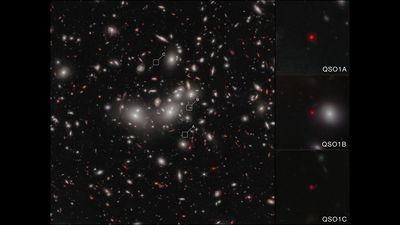
Enters QSO1. This object– full name Abell2744-QSO1 – existed just 700 million years after the Big Bang. It is one of the mysterious Little Red Dots, peculiar galactic objects of unknown origin. It was found in JWST observations thanks to gravitational lensing in the Pandora’s Cluster, AKA Abell 2744.
The gravity of this cluster warps spacetime and acts as a lens, and the light of the dim QSO1 was magnified and multiplied three times. Thanks to this gravitational lensing, a different research group had delivered some insights into it, and the team was able to conduct some pretty important measurements of how it rotates.
“It seemed already to be a bit of a weird source where you have a black rotating black hole and the host galaxy is too small to be seen,” lead author of one of the papers, Ignas Juodžbalis, a graduate researcher at the University of Cambridge, told IFLScience.
It turns out that there is no host galaxy, and if there is, there are so few stars that they are orbiting extremely close to the black hole.
This is a very naked black hole, and the rotation curve, the velocity, follows what would be more expected in something like the Solar System.
Ignas Juodžbalis
“We mapped the rotation curve, and using two different methods, we basically arrived at the same answer,” Juodžbalis told IFLScience.
“This is a very naked black hole, and the rotation curve, the velocity, follows what would be more expected in something like the Solar System, where planets further away move slower because most of the mass is in the Sun.”
If there were lots of stars, the mass would be more distributed. Also, the system is extremely metal-poor, with just 0.5 percent of the metallicity of the Sun. This means that it is almost exclusively made of hydrogen and helium, with little of the heavy elements, such as carbon and oxygen, that are created in stars.
The fact that QSO1 is one of the most pristine galactic environments ever measured tells us about the supermassive black hole's possible origin. The supernova scenario doesn’t work. There’s no enhancement in those heavy elements and not enough stars.
And yet, the supermassive black hole is 50 million times the mass of the Sun (although with some big uncertainty). This is an object 12 times the mass of the supermassive black hole at the center of our own galaxy, but it grew to that size in just 700 million years.
“It's very likely that we will solve the problem of where supermassive black holes come from within the next decade,” Juodžbalis told IFLScience.
“It's not necessarily from this measurement alone, but we have the power with JWST observations to perhaps do this for other strongly lensed sources.”
With the space telescope, astronomers are looking at the farthest reaches of the universe accessible to us. Hopefully it’s only a matter of time to solve the mysteries that lie there… and finding new ones along the way.
The study is published in two papers, one in the journal Nature and the other in the Monthly Notices of the Royal Astronomical Society.