Space and Physics
 PUBLISHED



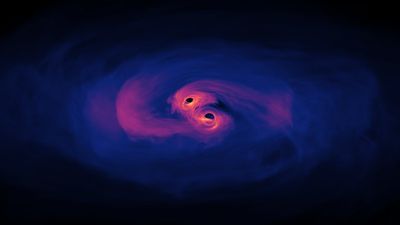


Astronomers have finally found two enormous black holes at the center of a galaxy that are on the verge of a merger. The discovery explains some longstanding mysterious features of one of the brightest black hole systems.
Most galaxies have supermassive black holes (SMBHs) at their core, and these are known to grow by swallowing others, like cities in Mortal Engines – yet we’ve only ever observed multiple SMBHs in relatively newly merged galaxies.
It’s not hard to work out that galaxies like our own must have gobbled up the black holes at the centers of many smaller galaxies in the past. Nevertheless, knowing it must happen and seeing it in action are two different things.
The galaxy Markarian 501 has an SMBH that has attracted great interest from astronomers because it is a blazar. This means one of the powerful jets produced by the SMBH at its core is pointing straight at Earth, making it exceptionally bright considering the 500 million light years between us.
The system is considered so interesting it was one of the first targets of the X-Ray Polarimetry Explorer space telescope, rewarding observers with the first detection of polarized X-ray radiation from space. New evidence reveals that this black hole isn’t alone.
The idea that Markarian 501 might host two SMBHs was proposed as far back as 1995, but until now no one had been able to confirm them.
A team led by Silke Britzen at the Max Plank Institute for Radio Astronomy in Germany studied 23 years of radio-frequency observations of Markarian 501 and detected traces of a second jet of charged particles that couldn’t be from the primary black hole.
"We searched for it for so long, and then it came as a complete surprise that we could not only see a second jet, but even track its movement,” Britzen said in a statement.
The second jet isn’t pointed at Earth, so it is much fainter. It’s not even possible to measure how luminous it is compared with the one pointed at us. Further complicating observations, the immense gravity of the system distorts not only the jet itself but the light coming from it.
At times, the second jet disappears behind the first one, but with an orbit of just 121 days, it should have re-emerged plenty of times over the years the system has been tracked, even though observations have only been intermittent.
At times, the gravitational field the light passes through creates a lens effect, producing an Einstein ring image of the jet. "Evaluating the data felt like being on a ship. The entire jet system is in motion,” Britzen said. “A system of two black holes can explain this: The orbital plane sways."
This is by far the narrowest separation we have ever seen between SMBHs, with an orbital period less than that of Venus around the Sun. As Newton revealed, orbital period is inversely proportional to the square root of the mass of the objects orbiting each other. Each member of this pair is between 100 million and a billion times as massive as the Sun (23-230 times the mass of the Milky Way’s Sagittarius A*).
Like giant versions of the stellar-mass black holes whose mergers we have tracked, this pair will spiral towards one another, shedding orbital energy in the form of gravitational waves. How long they will take to do this depends on their current distance.
If they’re at the closer end of the uncertainty range, the merger could be just 100 years away. If so, it would be an almost unique example of a galactic-scale event we know is coming and that, if not astronomers alive today, at least by their grandchildren might see.
When it happens, the gravitational wave will be immense.
Unfortunately, no existing telescope, nor any under construction, has the resolution to distinguish the accretion disks of the two black holes from this distance. Consequently, we won’t be able to directly observe the SMBH’s as they come together. However, their progress should be revealed in the shortening period of their orbit. If more than 20 pulsars can be tracked for a period of about 10 years, the authors think their timing could reveal gravitational waves created by their inward spiral, not just the final merger.
"If gravitational waves are detected, we may even see their frequency steadily rise as the two giants spiral toward collision, offering a rare chance to watch a supermassive black hole merger unfold,” said Héctor Olivares at Radboud University Nijmegen in the Netherlands.
The study is open access in Monthly Notices of the Royal Astronomical Society.