Space and Physics
 PUBLISHED
 1
1



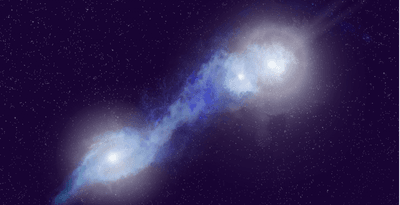


Galaxies might be separated by hundreds of thousands of light-years at the very least, but they do occasionally merge. During those collisions, the supermassive black holes that sit at the center of those galaxies can become active, entering a feeding frenzy thanks to fresh supplies of gas being thrown towards the core by the merger. For the first time, researchers report a three-way merger with all three supermassive black holes active and emitting in radio waves at the same time.
The system is known as J1218/1219+1035, and is located 1.2 billion light-years from us. The three nuclei of the three galaxies, where the supermassive black holes reside, have a separation of roughly 22,000 and 97,000 light-years. The merger is not imminent on human timescales, but they are getting there.
Large spiral galaxies like the Milky Way have grown in size thanks to interactions with smaller companions. Large elliptical galaxies are the product of collisions between spiral galaxies; likely how it will happen between the Milky Way and Andromeda in several billion years. Getting three galaxies merging is a lot less common, and getting all three of them active is rarer still.
“Triple active galaxies like this are incredibly rare, and catching one in the middle of a merger gives us a front-row seat to how massive galaxies and their black holes grow together,” lead author Dr Emma Schwartzman of the US Naval Research Laboratory said in a statement.
“By observing that all three black holes in this system are radio-bright and actively launching jets, we’ve moved triple radio AGN from theory into reality and opened a new window into the life cycle of supermassive black holes.”
The first indication that this system was intriguing came from infrared observations. That suggested a merger with potentially active galactic nuclei or AGNs. Radio observations using the US National Science Foundation Very Large Array (NSF VLA) and the US National Science Foundation Very Long Baseline Array (NSF VLBA) revealed more.
The radio observations do not suffer from limitations that both optical and X-ray observatories can experience when looking for the signature of AGNs. These two observatories combined to confirm the first detection of three radio AGNs in a merging system.
Supermassive black holes can grow to incredible sizes, but the process of that growth is not fully understood. Collisions between them are a possible pathway, and studying this and similar systems could provide insights into their evolution. The team is planning follow-up studies in radio waves and beyond.
The study is published in The Astrophysical Journal Letters.