


 Space and Physics
 PUBLISHED





I hope you've prepared some New Year resolutions, because today is officially Martian New Year!
Today, September 30, is the spring equinox on the northern hemisphere of the Red Planet. This also marks the start of the 39th year on Mars since the record began back in 1955. The choice of that year, in which the equinox fell on April 11, was a somewhat arbitrary one made many years later in 2000, when the modern Martian calendar was first proposed. It does, however, happen to coincide with a major weather event.
Mars is known for massive dust storms that tend to happen in the second half of the Martian year. The storms aren't like the one depicted in Andy Weir’s book and Ridley Scott’s movie "The Martian," – Mars’s atmosphere isn't dense enough to have fierce winds like Earth – but the dust can cover the whole planet. That’s what killed NASA’s Opportunity rover in 2018.
The great dust storm of 1956, which started during the Southern Hemisphere summer, was a particularly massive one, and so it makes a handy reference point.
Why don't we use Earth’s timekeeping on Mars?
There are no humans on Mars yet, but there is plenty of human-made stuff on and around the planet. If we were to simply use Earth’s calendars, they would fall out of sync with the planet's natural cycles very quickly; night would take place during daytime, and seasons would be all over the place.
The calendar problem is both daily and annual.
A solar day on Mars, or "sol," is 24 hours, 39 minutes, and 35 seconds long. This is obviously longer than Earth’s near-perfect 24 hours. If we kept the Martian rovers and landers on Earth time, within a week midnight would be in the morning.
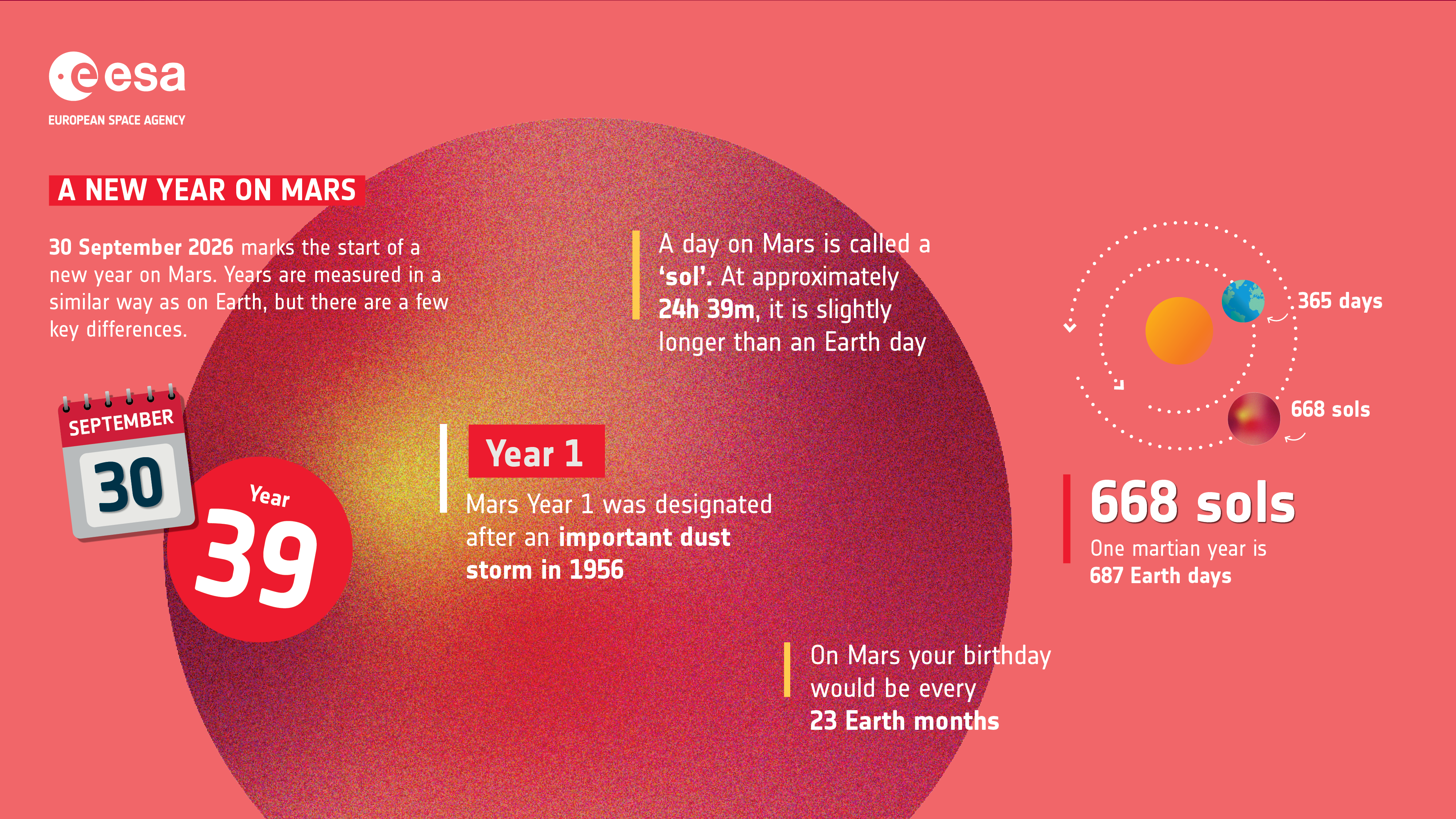
For this reason, a lot of missions to Mars, including NASA’s Curiosity and Perseverance rovers, count their time working on the Red Planet in sols rather than on Earth days. If the day alone was enough trouble, the year is also significantly different. A Martian year is 668 sols, or about 687 Earth days. So, if you want to work out your Martian age, you simply need to divide by 1.88.
Not your regular four seasons
The day and year are different, sure, but not wildly different in the grand scheme of things. Venus would be much worse: the sun returns to the same point in the Venusian sky every 117 Earth days, while a year is 225 Earth days long.
If we want weirdness on Mars, however, we can just look at the seasons. On Earth, the seasons are only due to the planet’s tilt of 23.5 degrees. This means that as our planet goes around the Sun, one hemisphere gets more light, and six months later things are the opposite. If you are getting more light, you are in your spring or summer.
Mars has a similar tilt, about 25 degrees, but this isn't the only contributing effect. While Earth’s orbit is roughly circular, Mars’ orbit is a lot more elliptical. This means the seasons aren't equal in length: the northern hemisphere's spring lasts longer than the northern hemisphere's autumn (192 sols compared with 142 sols).
And this reconnects the dust storm to the seasons. The southern hemisphere experiences shorter springs and summers, but as the planet is closer to the Sun in that period, it creates a more turbulent atmosphere. This turbulence is the reason for the dust storms, which are so impressive they can block the Sun for weeks.
The next Martian New Year will be on August 17, 2028.


 1
1