Space and Physics
 PUBLISHED





Mathematics, the legendary mathematician Carl Friedrich Gauss once famously declared, is the “Queen of Sciences.” I can’t disagree – and, having spent many thousands of pounds on studying the subject at university, neither would I want to – but I do have some notes.
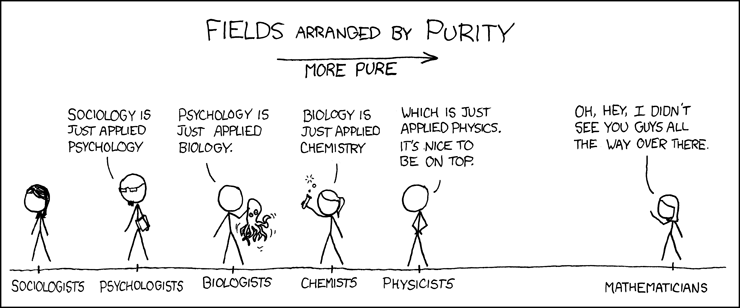
Because while, yes, Carl, you’re right, math is obviously the best kind of science out there, what you fail to mention is the corollary: that every other subject is just a little bitch, suitable only for intellectual cowards.
Listen, I know it’s a bold stance. But tell me this: what other discipline can produce the kind of abstract beauty that would make da Vinci weep and develop from first principles the laws that govern the very fabric of the universe and disprove those very same laws, all without breaking a sweat? What subject out there encompasses, as math does, every single other study you could care to mention? In what other field could you ever be a witness to true perfection?
Frankly, it’s a wonder we ever talk about any other subject at all.
The mother of invention
A couple of years ago, I interviewed two philosophers for their takes on whether math is real or invented. The answer, like just about any you’ll get from even one philosopher, let alone two, was complicated – but along the way, both pointed out something undeniable: that math really is the origin of every other discipline out there.
Seriously. Forgive the poetry – I can’t help it, I’m afraid, I’m a mathematician – but if “intellectual enquiry” is an oak tree, math is the acorn that grew it; in the so-called “web of science,” math is the spider. You think physics or computer science sent us to the moon? That biology governs the life cycles of cicadas or growth patterns of sunflowers? Nope, it’s all math, baby.
And the best part of all this? How often it happens totally by surprise. Math wants us to understand the universe; whenever we push the bounds of what’s possible, math is there with an elegant, clean, and often familiar solution to help us along.
Take the movements of the planets, for example. For centuries, we relied on our eyes and “common sense” to tell us how the solar system worked, and the result? A baffling system of “epicycles” and “deferents,” in which planets circled the Earth like they were attached to an increasingly complex and multi-layered celestial Spirograph set. Until, that is, math entered the fray, changed our perspective, and offered us conic sections: originally discovered in an attempt to double the size of a mystical altar, now a beautifully elliptical answer to a question that physicists had, frankly, botched.
“The mathematician may be compared to a designer of garments, who is utterly oblivious of the creatures whom his garments may fit,” wrote mathematician Tobias Dantzig in 1930’s Number: The Language of Science. “To be sure, his art originated in the necessity for clothing such creatures, but this was long ago […] delightful though these surprises may be, their discovery is not the moving force behind the creative work of the mathematician.”
Like the mysterious wandering planets, science is littered with mathematical solutions whose questions took centuries to be found. “The imaginary magnitudes invented by Cardan and Bombelli describe in some strange way the characteristic features of alternating currents,” Dantzig pointed out. “The absolute differential calculus, which originated as a fantasy of Reimann, became the mathematical model for the theory of Relativity. And the matrices which were a complete abstraction in the days of Cayley and Sylvester appear admirably adapted to the exotic situation exhibited by the quantum theory of the atom.”
A deep and monstrous beauty
Beauty, it is said, is in the eye of the beholder. Well, I hate to go fractal with the hot takes, but that’s not true – and as proof, I offer you this:
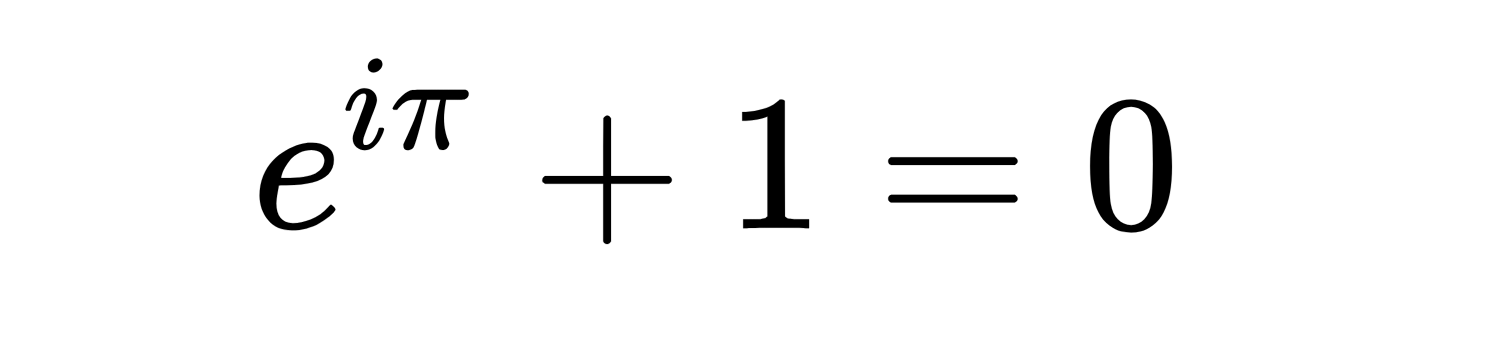
It’s called Euler’s identity, and it is, almost every mathematician agrees, the most beautiful thing in the world. “[It’s] like a Shakespearean sonnet that captures the very essence of love, or a painting that brings out the beauty of the human form that is far more than just skin deep,” Stanford University mathematics professor Keith Devlin wrote in Wabash Magazine in 2002.
“Euler's equation,” he declared, “reaches down into the very depths of existence.”
It’s an impact you don’t really get with other subjects. Sure, the physicist may marvel at the shapes and colors of galaxies; the psychiatrist or biologist might wonder at the capabilities of the human brain – but these are merely the objects of their study, not the study itself.
Math is different. It’s abundant with these mysterious, transcendental objects that turn up time and again in places that could hardly be further apart: a weird little constant somewhere a little above three on the number line is proven by some Greek guy to be present in every circle he draws; 1,500 years later, it turns up again as the limit of an infinite sum of alternating odd fractions; by the late 1920s, it’s emerged again in the limit of measurable reality. We may not know how, or why, but it’s clear that, with math, everything is connected. Everything is discoverable. Everything is perfect.
Contrast that with, say, the physicists’ take on pi – basically, “it’s 3.142, right?” – or worse, the engineers’, which seems to amount to “it’s about 3.” Where’s the appreciation? Where’s the rigor? Where’s the respect? Charlatans, the lot of them.
Feynman rebuffed
Tell any of this to a physicist – in my experience the most easily butthurt of scientists, likely because they know how close they came to the good stuff, but had to tap out, and are resentful – and they’ll likely reply with a quote: “physics is to math,” they’ll sniffily say, “what sex is to masturbation.”
It was originally said by Richard Feynman, according to the lore, and like many of his famous quotations, it’s pretty funny. But before you quote it at me, remember these two things: first, Feynman was a wife beater, so jot that right down; and second – well, masturbation has a lot going for it, to be honest.
After all, it never lets you down. It’s always available, no matter your circumstances. It lets you explore limits without judgement. It has frequently been considered dangerous by authority figures. Physicists don’t seem to get it. It is, in fact, rather like math in many ways.
And there’s something else math and masturbation share: their longevity. Sexual trends and mores may change, but wanking endures. And while physics models may come and go, and chemicals are born and die in stars without us ever knowing they existed, math outlasts it all. It was the first science humans discovered, and it’ll exist long after we’re gone.
“[M]athematics is ‘permanent’, more permanent even than […] literature,” declared mathematician G. H. Hardy back in his 1941 Mathematician’s Apology. “Archimedes will be remembered when Aeschylus is forgotten, because languages die and mathematical ideas do not.”
“‘Immortality’ may be a silly word,” he added, “but probably a mathematician has the best chance of whatever it may mean.”
IFLScience Hot Takes is a semi-satirical Opinion column where we take a silly or outrageous idea and argue for it as if it's our earnestly held belief… as long as we can find good scientific reasons to back it up.
Do you agree with Katie? Or do you think physics (or, God forbid, biology) has more of a claim to the throne?