Space and Physics
 PUBLISHED


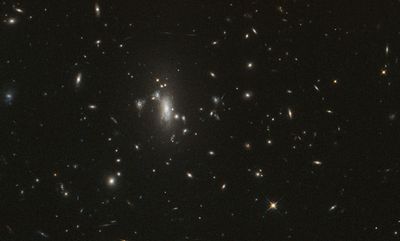


Supernovae are, as far as we know, unpredictable. Occasionally a star goes boom in a galaxy near or far. There is an exception to the rule, though, and humanity is about to see a star going supernova in the next few months.
We have a peculiar warning sign that this is going to happen: we have seen this star explode before.
No, the Space Telescope Science Institute (STScI) has not hired some soothsayers, and there’s no magic involved. It all rests on a peculiar phenomenon known as gravitational lensing.
A dense object, like a black hole, a galaxy, or a cluster of galaxies, can warp spacetime in such a way that it acts like a lens. Background objects behind this gravitational lens can become distorted and magnified, their images multiplied several times.
The fact that the mass of these objects is often distributed in peculiar ways, and that light has an unbreakable speed limit, means that the images we see are not simultaneous. In some cases, the light takes a lot longer to get to us.
This is the case of Supernova Athena, spotted by the JWST in 2025 from a galaxy that existed when the universe was half its current age.
.png "One image shows gravitationally lensed system. Two galaxies have multiple images and arrows point which images will see a supernova again in the future.")
That galaxy’s light was warped by galaxy cluster MACS J0417, and it is expected that one of the images is up to two years behind the one showing the supernova. So, the supernova will appear any day between now and March 2027. And Hubble is keeping an eye on it.
Studying the supernova will allow us to better constrain the mass of the galaxy cluster. It can also provide insights into supernovae themselves.
If those were not important enough scientific goals already, the supernova could also help solve the so-called Hubble Tension. The universe is undergoing an accelerated expansion, but the two main methods to measure the expansion rate (Hubble Constant) do not agree with each other.
“The predicted time delay to the next image of SN Athena of a few years will allow us to weigh in on the value of the Hubble Constant at a time when such an independent measurement is sorely needed,” Justin Pierel, an Einstein Fellow at STScI, who worked on the discovery, said back in January.
“It may help to cement the possibility of new physics, or alternatively, point to unknown systematics in the best current cosmological analyses.”
If Supernova Athena is not exciting enough for you, consider Supernova Ares. A similar setup, but a more extreme time delay. It is not expected to come back until 2086. Make sure your kids and grandkids know about it!