Space and Physics
 PUBLISHED





People of the Internet are back on their bullshit. As well as claims of UFOs popping up during SpaceX rocket launches, it appears that old claims of secret asteroid swarms are circulating once again.
In a video which now appears to be removed from TikTok, but documented by fact-checking platform BiasBreak, an old conspiracy theory racked up around 4.2 million views. The video, far from the first of its kind, suggested that there is a 96 percent chance of life being wiped out on Earth in the year of 2027.
Adding unearned credibility to these claims in previous videos are NASA screenshots taken out of context.
Old conspiracy theories repeated
Such claims have been circulating for years, but it's perhaps no surprise that the videos began popping up again in 2026, less than a year before when the asteroids were supposedly going to hit.
"Based on new tracking measurements taken this week, the International Asteroid Warning Network (IAWN) has confirmed that asteroid 2017 PDC is on a course that will almost certainly impact Earth on July 21, 2027, less than nine years from now," such screenshots read.
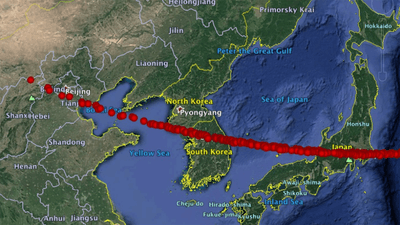
"IAWN estimates that the chance of impact is 96%, and the possible locations of impact are confined to a long narrow region outlined by the red dots on the image below."
So, why are we so sure that this is nonsense?
The part that these videos conveniently crop out, or disguise by showing a screenshot of a Google search page, is that this all came from a training exercise run by NASA which we handily covered back in 2019.
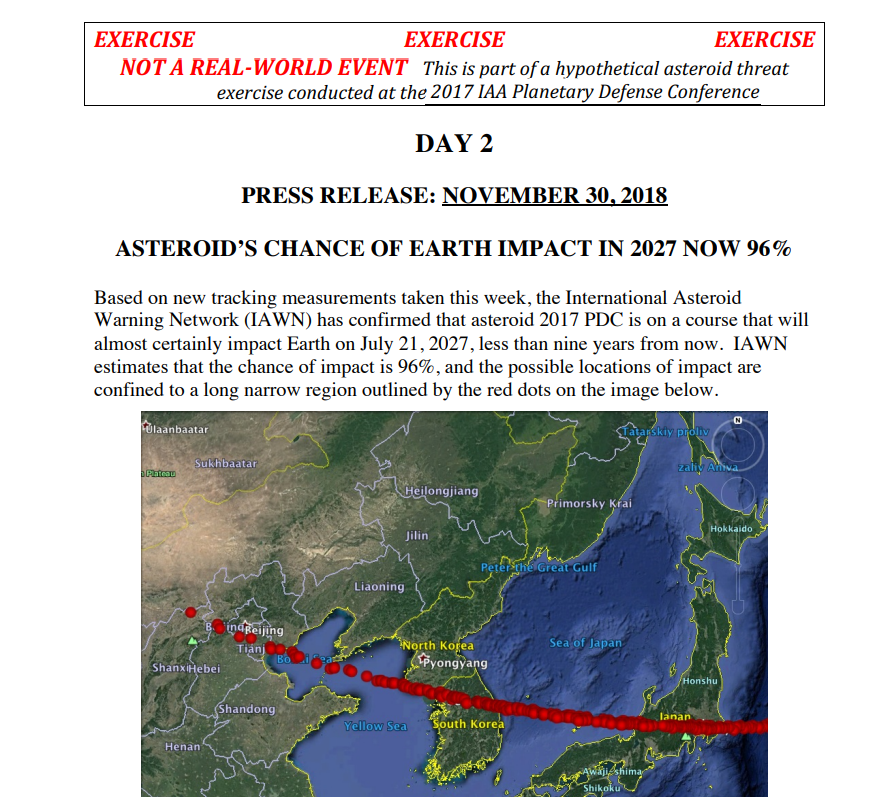
NASA training exercise
NASA runs these scenarios every now and then, presenting teams with a pretend asteroid which they then must react to, either by launching a deflection mission or by mitigating loss of life on the Earth, largely through evacuation.
"The team wanted to provide a fake but realistic scenario," Dr Alfredo Carpineti explained of the exercise back then.
"If this fake asteroid were a reality, it could create devastation on a continental scale. Given the uncertainty about the object, it could land on April 29, 2027, in a narrow band that extends from Hawaii to Africa, crossing the continental United States."
In the exercise, the team designed an asteroid deflection mission, which was simulated to not go so well.
"Once they found out it was on a certain collision, NASA and space agencies around the world decided to send a fleet of kinetic impactors to deflect the asteroid," NASA explains of the exercise, which we'll stress again was not real.
On the final day of the conference, the team simulated the response to a now near-certain impact with New York on April 29, 2027, with 5-20 megatons of energy.
"Bringing together the disaster management community and the scientific community is critical to preparing for a potential asteroid impact in the future," Leviticus Lewis of the Response Operations Division for FEMA said at the time.
"This exercise is valuable in that it continues the work currently in progress to identify key questions and issues for this low probability but high consequence scenario."
While NASA and other astronomers constantly monitor the skies for any potentially hazardous asteroids, and occasionally find one to keep a close eye on further down the line, the US space organization has ruled out any impacts from larger, known asteroids for at least 100 years.
Unfortunately, they regularly run these asteroid scenarios meaning that despite there being no immediate danger from asteroids, the screenshots you see on TikTok might make it look otherwise.
As always, don't trust everything you read on the Internet. Except this, obviously.