Space and Physics
 PUBLISHED


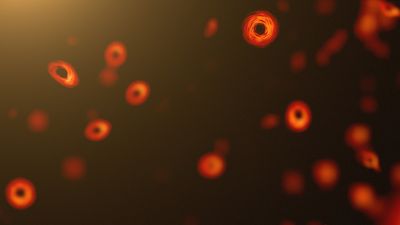


In the instants after the Big Bang, black holes might have formed in the extreme conditions at the birth of our universe. The objects have never been seen, but their existence is intriguing and hotly debated by theorists. A new proposal pushes them beyond the dimensions we experience, spreading them into the so-called “dark dimension.”
Yes, we are aware that it sounds like a fantasy or sci-fi place (Marvel has its own dark dimension), but it has some scientific backing. According to string theory – a possible candidate for the theory of everything – there are more dimensions in the universe than the three spatial ones, plus time, that we experience.
The dark dimension would serve to explain dark energy, a hypothetical component of the universe that is responsible for the accelerated expansion of the cosmos. Unlike the other extra dimensions that are so small we can’t even probe them with our technology, the dark dimension is in the range of microns.
In string theory, all particles are made of vibrating strings of energy. According to the dark dimension theory, annihilating strings in a vacuum would release energy consistent with dark energy if there were a micron-sized dimension from which to leak out.
If a micron-sized dimension is difficult to picture, consider an electric cable out in the street. At a distance, it would appear to have only one dimension, making it a line. But up close, you’d see it is really a cylinder. Similarly, only by zooming in to the miniscule world can we see that this extra dimension potentially (the work is very preliminary) exists.
And what about primordial black holes? These were not formed in the collapse of stars, like regular stellar black holes. This allows them to be much lighter than even the smallest black hole we have seen in the universe.
Research-led physicist Luis Anchordoqui of Lehman College and colleagues looked at a scenario whereby you do have a universe with a dark dimension. What would it mean for primordial black holes? It would mean that they exist in more than just our four spacetime dimensions – they might extend into the fifth.
In particular, if these black holes were formed by the collapse of a cosmic string – another hypothetical object, a defect in the fabric of spacetime – they would be massive enough to survive all the way to the present day.
The existence of these black holes could explain the recent detection of a high-energy neutrino by the KM3NeT detector. This event has been linked to primordial black holes before.
As we said, there is no evidence that primordial black holes exist, but we will soon have a telescope that can look for at least some of them.
The Roman Space Telescope will be hunting for free-floating planets by spotting subtle gravitational lensing effects as these worlds that have escaped star systems pass in front of background sources of light. With this approach, known as microlensing, Roman might be able to spot black holes too.
A black hole too small to be produced by a supernova would be indisputable evidence that it is primordial. Whether it exists in more dimensions than we can currently study would remain to be seen.
The study is published in the journal Physical Review D.

 1
1