Space and Physics
 PUBLISHED


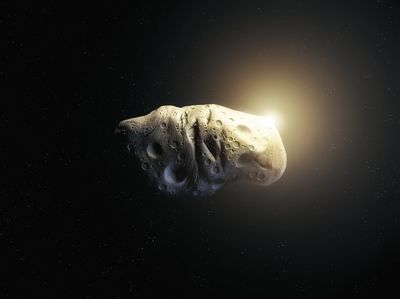


An animation of an asteroid's close approach to Earth has garnered considerable interest in recent times, largely due to its apparent proximity to our planet.
The animation, shared by Facebook page Cosmoknowledge, shows asteroid 99942 Apophis's path, culminating in its closest approach on April 13, 2029. To be clear, there is nothing to fear from this asteroid, which is predicted by NASA not to hit Earth in 2029, nor in another close approach in 2036. However, the animation is still what is known as a nail-biter.
In April 2029, Apophis is predicted by NASA to come within 32,000 kilometers (20,000 miles) of the Earth's surface. Closer than some satellites, it should be visible from the Eastern Hemisphere without the aid of a telescope or binoculars.
It may sound close (in terms of space that is, not in terms of a jaunt) but astronomers are not concerned. In 2021, Apophis made a flyby of Earth, at which point astronomers made powerful radar observations in order to better define its orbit. Before that, NASA believed that it had a chance of impact later in the century, but the observations ruled that out.
“A 2068 impact is not in the realm of possibility anymore," Davide Farnocchia of NASA’s Center for Near-Earth Object Studies said of the asteroid, "and our calculations don’t show any impact risk for at least the next 100 years."
Other animations, a little closer and from a different angle, are more reassuring. NASA's Eyes On Asteroids website also provides more detailed views of this and other asteroids, for anyone who has a bit of free time and fancies feeling at the mercy of random space rocks.
NASA is going to use the 2029 flyby to take a better look at the asteroid, named for the Egyptian serpent deity that wanted to devour the Sun, using the spacecraft that returned samples from asteroid Bennu. A little science cherry on top of the main treat? That we aren't going to be hit by a big rock from space.