Space and Physics
 PUBLISHED


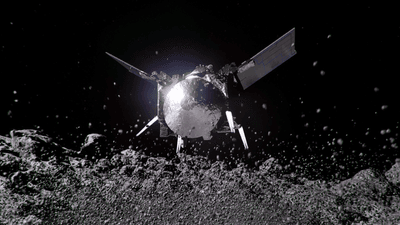


As NASA struggles to access the treasure obtained by the OSIRIS-REx mission to Bennu, it has also had to decide what to do with the valuable and still-operating spacecraft responsible. Now that decision has been made, confirming a long-standing plan, with the target set for an even more-famous Earth-crossing asteroid, 99942 Apophis, and a tweak to the mission name.
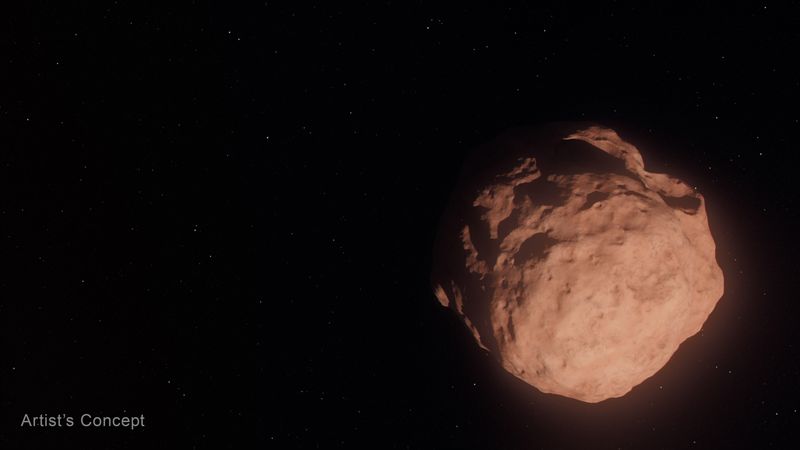
Because of its potential threat to Earth, Apophis was given its name after the Greek for the Egyptian evil serpent deity who sought to swallow the Sun and destroy the world. When first observed, there appeared to be several times in the near future when the asteroid might impact the Earth. Although more detail on its orbit has allowed astronomers to rule out a collision in the next century, there is no guarantee much beyond that.
Indeed, if we do not do something to intervene, the chances are better than even that Apophis will hit Earth eventually – the only alternative is a close passage moving it to an entirely different orbit. Even this passage will lengthen its orbit by 100 days, while still allowing many more close encounters with Earth.
Apophis isn’t large enough to be a mass extinction-causing “dinosaur killer”, but you would certainly not want to be where it hit, or possibly even on the same continent. Knowing more about it could be crucial when the time comes to give it a nudge.
Moreover, OSIRIS-APEX, as the mission is now known, will observe Apophis as it passes just 32,000 kilometers (20,000 miles) from the Earth – geostationary satellites orbit higher than that. For suitably placed humans, the passage will be visible to the naked eye even under moderate light pollution.
If you’re wondering what the new acronym stands for, it’s Origins, Spectral Interpretation, Resource Identification, and Security – APophis EXplorer, which is a lot less stretched than some.
It’s thought asteroids this large pass so close only once every 7,500 years. The Earth’s much larger gravity could unleash effects on Apophis like those in an over-the-top disaster film, and OSIRIS-APEX will watch the whole thing.
“OSIRIS-APEX will study Apophis immediately after such a pass, allowing us to see how its surface changes by interacting with Earth’s gravity,” said Dr Amy Simon of NASA's Goddard Space Flight Center in a statement.
Passing that close to an object as massive as the Earth could change the length of Apophis’ day – currently 30.6 Earth hours. NASA also thinks it could set off Apophis-quakes that could uncover material currently hidden inside.
“The close approach is a great natural experiment,” said Dr Dani Mendoza DellaGiustina, principal investigator for OSIRIS-APEX at the University of Arizona in Tucson. “We know that tidal forces and the accumulation of rubble pile material are foundational processes that could play a role in planet formation. They could inform how we got from debris in the early solar system to full-blown planets.”
There is a more immediate reason to study Apophis. It’s an S-type asteroid, meaning its spectrum includes a lot of silicon. Besides Apophis being arguably the most threatening known space rock, most of the other known threats come from S-type asteroids. On the other hand, Bennu and Ryugu are both carbonaceous.
Appropriate asteroid defense mechanisms may vary between asteroid types, so learning about the common ones is probably a good idea.
It’s still a long way for OSIRIS-APEX to catch Apophis, and it will need six passes by the Sun and three of the Earth to suitably adjust its orbit. Consequently, it won’t arrive until April 2029, shortly before Apophis’ April 13 Earth pass. It will keep watching for 18 months thereafter, and unlike Earth-based telescopes, won’t have its view overwhelmed by solar glare at some of the most crucial points.
OSIRIS-APEX lacks the capacity for another sample collection, but it will do the next best thing – getting to within 5 meters (16 feet) of the surface and firing its thrusters to see how much dust gets blown off. To avoid compromising the natural experiment, this will only occur after the close pass of Earth.


 1
1