Space and Physics
 PUBLISHED


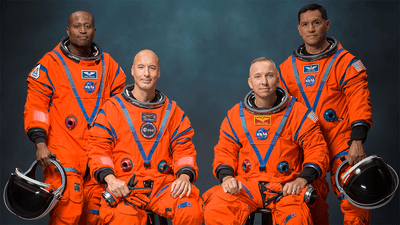


NASA has announced the crew for Artemis III, the next stage of the US space program's attempt to deliver humans back to the surface of the Moon. Whilst Artemis III was originally slated to land on the Moon's south pole, that is no longer the case. Nevertheless, the crew will have an interesting mission ahead of them, even if it isn't as fun as the Artemis II mission, nor the upcoming Artemis IV and V.
During the Apollo era, we had Apollo 9, which tested key landing systems ahead of the big day; Apollo 10, which tested all procedures but the final landing part; and Apollo 11, which finally took humans down to the Moon. In the Artemis missions, we have had Artemis I, the uncrewed mission around the Moon, followed by Artemis II, which saw humans go around the Moon for the first time in half a century.
So what's in store for Artemis III? Unfortunately, for people eager as we are to see humans set foot on the Moon, it's not that, and is a mission more approaching Apollo 9 than 10. But it is still pretty cool, and vital for the next step of the Artemis program, lasting around two weeks.
"The crew will fly their journey in low Earth orbit on a circular trajectory around Earth. Orion and the Blue Origin lander will rendezvous in space, spending about two days in docked operations conducting test technology demonstrations, including inside of the Blue Origin spacecraft," NASA explained in a press conference held today.
"More importantly, we intend to dock, perform integrated stack control, have crew cross the hatch, operate the lander, and get critical tests of the life support systems that can only be done in space. This gives our teams key information on systems the lunar lander crew will depend on in an environment close to home versus four-plus days away around the Moon."
From there, Orion will detach and await SpaceX's Starship, which it will then dock and remain with for two days prior to the return journey home.
Meet the crew of Artemis III
The lineup, announced in a conference today, is as follows:
On standby, in case any of the crew should drop out, is test pilot, Air Force Colonel, and former SpaceX Crew-4 pilot, Bob Hines. The commander will be NASA astronaut Randy Bresnik, ESA (European Space Agency) astronaut Luca Parmitano will be the pilot, whilst NASA astronauts Andre Douglas and Frank Rubio will be mission specialists on board Orion.
“Artemis III will push the boundaries of spacecraft operations in orbit. Luca’s assignment as pilot reflects the depth of European expertise in human spaceflight and draws on his extensive operational experience in high-pressure situations,” Josef Aschbacher, ESA’s director general, added in a statement.
“At the same time, ESA’s European Service Module will once again provide the critical capabilities that power Orion, demonstrating Europe’s enduring role at the very heart of the Artemis program. The news out of Houston today is a powerful recognition of ESA’s role in enabling humanity’s return to the Moon – and a key advancement in our partnership with NASA. Europeans can take pride in being part of this exciting journey.”
Why is it taking so long to return to the Moon?
Essentially, it would be a real bummer if anything went wrong. NASA wants to be really sure of astronaut safety when the time comes to land on the lunar surface. But a bigger part of the problem is a lack of a vehicle to take humans down to the Moon.
Orion took the crew of Artemis II around the Moon, but it was never designed to land upon it. The current plan on that front is to have a separate vehicle – designed and made by Elon Musk's firm SpaceX – waiting for the crew to arrive around the Moon.
"Orion will dock with the SpaceX’s Starship Human Landing System (HLS) that will be waiting for the spacecraft in an orbit that brings it relatively close to the Moon every six and a half days," the European Space Agency explains.
"The novel lunar orbit is called a Near Rectilinear Halo Orbit that brings spacecraft close to the Moon’s surface and then flies in an elongated ellipse further away from the Moon."
It's a cool plan, but it don't mean squat if it cannot be delivered, and on that front, SpaceX has at least been slow. In an update in March, NASA's inspector general said that there had been around two years of developmental delays for the ship, per Reuters.
Among the problems are that the ship will need to be refueled in space by around 11 refueling ships, which will then have to dock with the HLS, in operations that have never been attempted at that scale before. NASA is currently concerned that the technology for transferring cryogenic propellant will "not be adequately mature" ahead of a 2028 landing. Nevertheless, with Artemis III, NASA takes another small step towards landing on the Moon once more.
"Think about how many spacecraft, all of which will eventually carry human beings, will be in orbit at the same time, from Dragon, Shenzhou, Soyuz, possibly Starliner, Starship, and Blue Origin landers," NASA Administrator Jared Isaacman added.
"This seems like the beginning of the future that we imagined as children. This seems like the very beginning of Earth's first Starfleet to me."