Space and Physics
 PUBLISHED
 2
2




Schrödinger’s cat, famously, is both alive and dead – but what if it could be something else as well? Researchers at the University of Oxford have discovered not one but an entire family of weird states that subjects can exist in – and when quantum scientists think something is strange, you know you’re in for some fun.
“One of the most fundamental and remarkable aspects of quantum mechanics is superposition, where quantum objects can exist in multiple states simultaneously. This phenomenon was famously described by Schrödinger using the example of a cat that is both dead and alive,” begins a new paper describing the team’s work. “Superpositions are not just a curiosity of nature but are central to any application of quantum mechanics.”
Now, superposition may seem counterintuitive – indeed, the entire concept of a cat being alive and dead at the same time was originally intended to mock the idea for being too obviously absurd to be correct – but it’s also objectively rather simple. Alive or dead; wave function or particle; these things may be uncertain, but they’re ultimately going to be either one thing or the other.
Not so with the new family of quantum superpositions.
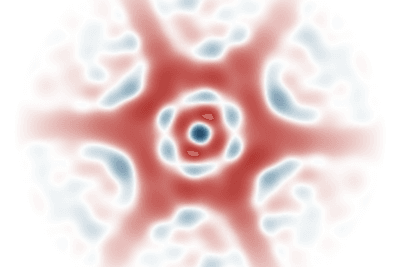
Created from “squeezed” components which are already very weird, put together in ways far more potentially complex than your standard “cat state” superpositions, these can be “sculpt[ed] […] into almost any shape,” explained Dr Sebastian Saner, a visiting researcher at the University’s Clarendon Laboratory and lead author of the paper, in a statement on the results. “The states we produced exhibit rotational symmetries and form striking geometric interference patterns.”
It's not just that these states exist in theory: by applying the techniques to a single strontium-88 ion, the team were able to exert full control over which state it took. Then, by rifling through each of the possibilities and measuring the states at each point – remember, you can’t see the full superposition all at once, as measuring it forces its collapse – they used a process called state tomography to reconstruct the original quantum superposition.
The results were intriguing, to say the least. “The superpositions created, especially the odd ones, have a large amount of Wigner negativity,” the paper notes – a striking feature that only occurs in highly quantum states, and one which “yield[s] an advantage over classical computation and hence are highly sought after.”
In other words, these new quantum states are knocking right up to the edge of what’s currently possible in physics and computation.
The techniques, the team points out, can be applied to a range of physical systems – from superconducting circuits in computing to nanoparticles; from atoms coupled to a cavity in optics to optical tweezers in nanoengineering and medicine, and more – “these superpositions could be used to test not only the boundaries of the classical and quantum world, but how quantum physics interacts with gravity,” the paper concludes.
“We believe we're still scratching the surface of what's possible,” said Dr Raghavendra Srinivas, an EPSRC Quantum Technologies Fellow from the Department of Physics at the University of Oxford, who supervised the work. “Both for practical applications and for understanding these states at a more fundamental level.”
The study is published in the journal Physical Review X.