Space and Physics
 PUBLISHED
 11
11



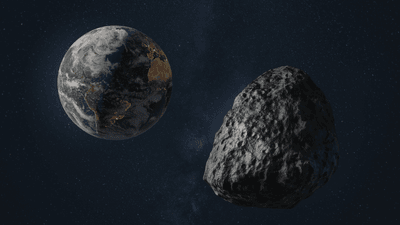


For many years, Apophis was considered the most dangerous known asteroid. Astronomers calculated it had a small chance of hitting our planet either in 2029 or, if that was a miss, in 2036. More precise observations of its orbit over the years have shown that it will actually come as close as 40,000 kilometers to Earth in 2029 but will definitely miss us – as long as a natural collision between Apohis and another passing object doesn't change its orbit. Astronomers have now calculated what that risk is.
For those on Team Asteroid, you should know that a 335-meter (1,100-foot) object such as Apophis wouldn’t send us the way of the dinosaurs. It would create vast devastation though and for this reason, scientists remained alert and curious about the possibilities. On April 13, 2029 (yes, a Friday 13th), Apophis will get just 37,399 kilometers (23,240 miles) from Earth. A little nudge from another object between now and then might create a large deviation in the future. After all, when NASA's DART mission redirected asteroid Dimorphos, it demonstrated just that (as well as completely changing its shape).
"Given how closely Apophis will pass Earth, there is a possible risk that a deflection from its current trajectory may move Apophis closer to impacting us," co-author Benjamin Hyatt, an undergraduate student at Waterloo University, said in a statement. "Hypothetically, another asteroid colliding with Apophis could cause such a deflection, motivating us to study this scenario, however unlikely it may be."

To investigate, Hyatt and lead author Professor Paul Wiegert from Western University calculated the trajectory of 1.3 million known asteroids in the Solar System. They looked at how these space rocks would move over the next several years to see if any might get too close to Apophis, and if they did, whether Apophis would be sent on a more dangerous course. Luckily, their results show that there is zero chance of that happening.
"We calculated the paths of all known asteroids using a detailed computer simulation of our Solar System and the possibility of such an unlikely event was evaluated," said Wiegert. "Fortunately, no such collisions are anticipated."
So, we are safe from Apophis but we won’t stop studying it. In fact, there is a mission currently traveling to study it right now: OSIRIS-APEX, the mission formerly known as OSIRIS-REx that visited the current most dangerous known asteroid Bennu, bringing back a huge sample of it, including something we've never had before.
"Asteroid Apophis has fascinated us as a species since its discovery in 2004: it was the first credible threat from an asteroid to our planet," said Wiegert, a member of the Institute for Earth and Space Exploration. "Even now that we know it's on course to miss us by a safe margin, astronomers remain vigilant. It's the asteroid we just can't stop watching."
The study has been accepted by the Planetary Science Journal and is available on the arXiv preprint server.