Space and Physics
 PUBLISHED
 1
1





If you had been coming of age in 1570 and lived another 30 years, you would have been lucky enough to see not one but two supernovae in the sky – including Kepler’s supernova, which was visible during the day for weeks. For those of us born at the end of the last millennium or at the beginning of this one, supernovae are just something to see through telescopes. But thanks to a chance alignment, we can tell when two of them will happen in the coming years and decades.
We do not know enough about the death of stars to be able to predict when a supernova is going to take place. If we did, we wouldn’t be so bloodthirsty for Betelgeuse's final demise every time the giant star does something weird. There are ways, though, for humans to predict a supernova, as long as we have seen it before. The trick is gravitational lensing.
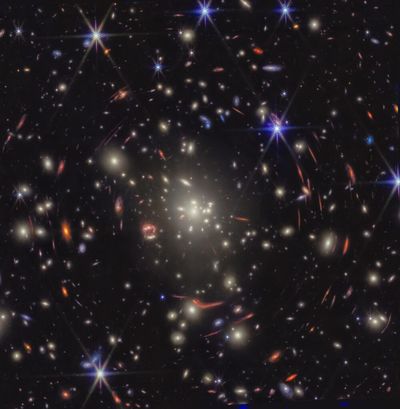
The presence of a massive galaxy cluster in the foreground of an astronomical observation can lead to this gravitational lensing phenomenon. Basically, the mass of this cluster warps spacetime in such a way that it acts like a lens, magnifying the light of distant objects. The phenomenon can create multiple images of the same background galaxy, and given that the lensing cluster is huge and not uniform, these different images show the same background galaxy at different times.
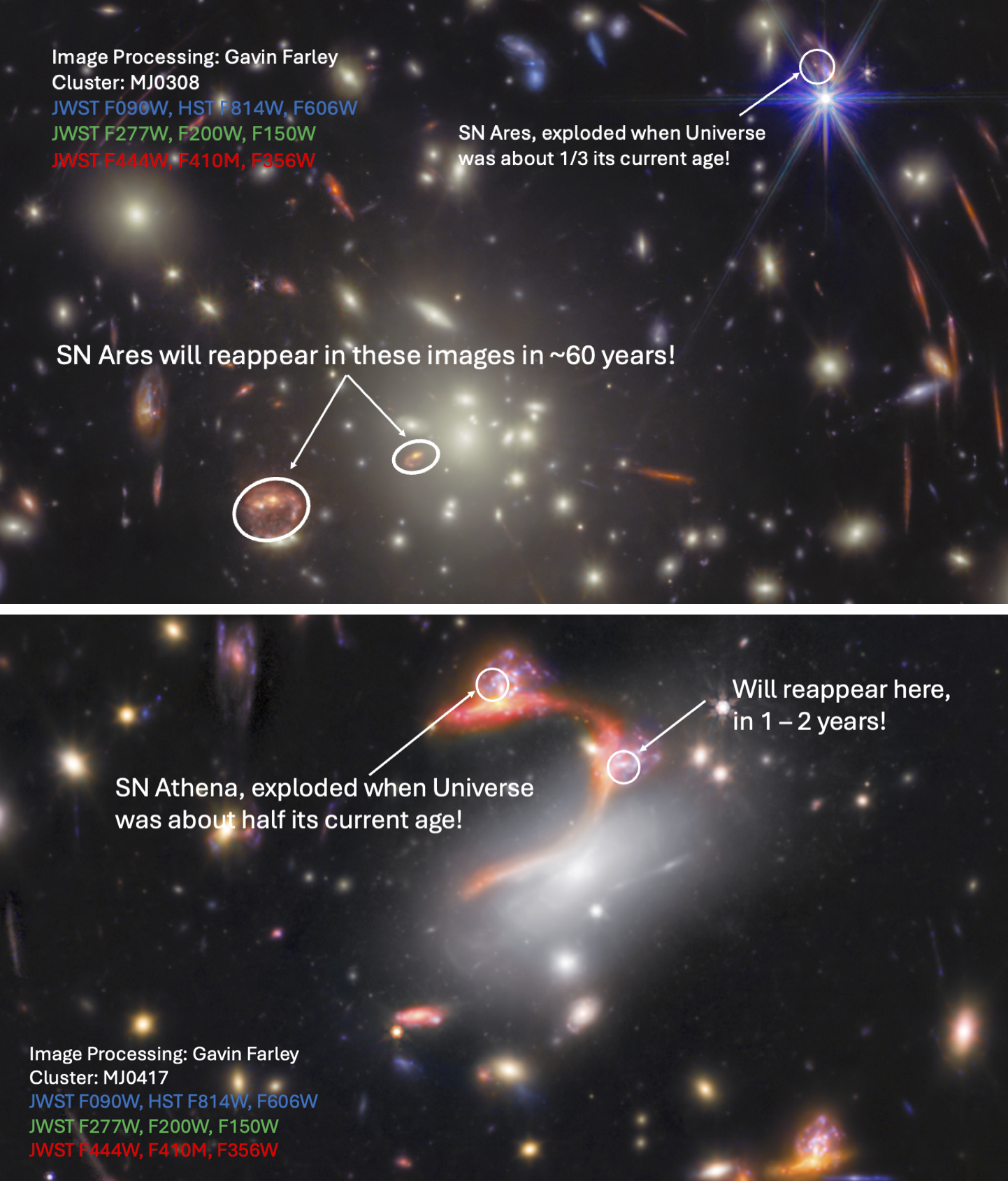
Researchers used JWST to study 60 rich clusters of galaxies. The program is called Vast Exploration for Nascent, Unexplored Sources (VENUS), and it is not even halfway through. Still, researchers found two supernovae that are being strongly lensed, and whose light is appearing only in one of the images. That means we will see those supernovae again.
SN Ares might be the most exciting one. The star exploded when the universe was about one-third of its current age. Researchers estimate that we will be able to see this explosion again in 60 years. So tell your kids and grandkids to be ready for it in 2086!
“Such a long anticipated delay between images of a strongly lensed supernova has never been seen before and could be the chance for a predictive experiment that could put unbelievably precise constraints on cosmological evolution,” Conor Larison, a postdoctoral research fellow at Space Telescope Science Institute (STScI) and member of the VENUS program, said in a statement.
Cosmological evolution is a crucial topic in astronomy today. The Hubble Constant, the rate of the expansion of the universe at this moment, has hit a bit of a rough patch as the two main methods to estimate it keep finding different numbers.
“It is hard to know what the key questions of the day will be in 60 years, but what is certain is that this reappearance will provide the most precise, single-step measurement of cosmology we have ever had the chance to make,” Larison explained.
This approach could provide a new, independent method to resolve the Hubble Tension. While the 60-year difference would provide greater accuracy, we do not have to wait that long. A second strongly lensed supernova has been found, SN Athena, which is expected to reappear within just the next one to two years.
“The predicted time delay to the next image of SN Athena of a few years will allow us to weigh in on the value of the Hubble Constant at a time when such an independent measurement is sorely needed,” added Justin Pierel, an Einstein Fellow at STScI, “It may help to cement the possibility of new physics, or alternatively, point to unknown systematics in the best current cosmological analyses.”
It is wild that we can see the same event happen again and again naturally, thanks to the distortion of spacetime created by gravity. It is even more incredible that this might allow us to uncover some fundamental truth about the universe.
The current insights from the VENUS program were presented at the 247th meeting of the American Astronomical Society.