


 Space and Physics
 PUBLISHED



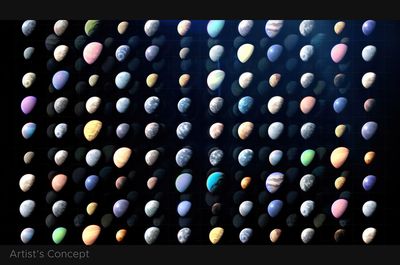


In about three decades, humanity has gone from barely knowing that there were planets beyond the Solar System to confirming the presence of at least 6,273 exoplanets, with thousands more waiting for confirmation. Now researchers have delivered a boatload more in a single go. By reanalyzing data from the first year of NASA’s Transiting Exoplanet Survey Satellite (TESS), they were able to discover 11,554 planet candidates.
This is an enormous number of possible worlds. Of them, 411 were seen only in a single transit in front of their star, so the team didn't attempt to work out their orbital parameters. Some 1,052 of the detections were already known candidate exoplanets. The remaining 10,091 had never been spotted before.
The team tested their detection method on star TIC 183374187 and found that its candidate was indeed a hot Jupiter, a large gas giant orbiting very close. Their pipeline appears to be successful.
“Instead of looking at only the bright stars, which has been done previously, we expanded our search for planets to include fainter stars,” lead author Joshua Roth, a graduate researcher at Princeton University, told IFLScience.
“This just gives us a much larger base of stars that we can search for these planets. We developed a semi-automated pipeline that incorporates some machine learning to go through tons of this data and find planets. And we found about 10,000 new planet candidates.”
TESS discovers planet candidates by looking at starlight. A planet passing in front of its star creates a tiny dip in the light. There are other reasons for the light of a star to change, though, so the work to confirm candidate detection has to be meticulous.
Just as meticulous is the process of going from candidate detection to a confirmation of planetary status. That needs to be done with a different method. So the researchers plan to follow up on their detections to confirm that they are indeed there, and they have already received collaboration requests to do so.
The data in this work come from the first year of observation from TESS, which was launched in 2018. Those observations covered about half of the sky. The researchers are now working on the second year of data and have changed some things about their methodology.
“The next step will be to follow them up and to search more TESS data,” Roth told IFLScience. “We're taking a slightly different approach for the second year.”
The team has upgraded their search to look at stars that were observed at different times through the year, allowing them to find planets that have a longer period around their stars. They hope this will also give a better signal-to-noise ratio and enable them to identify smaller candidates.
Bringing over 10,000 planet candidates in a single go, and maybe being able to double that with the data from the second year, is incredible. The field continues to make major leaps forward.
“I think what I'm most excited about is that this is a sign of this transition in exoplanetary science as a whole, that we're sort of transitioning from the study of individual systems to having the facilities and the instruments and telescopes to perform these huge demographic-based surveys that hopefully really shine light on some of the planetary environments that we just haven't been able to probe,” Roth told IFLScience.
“I'm really excited for the future of the field!”
A paper describing these findings is accepted for publication in The Astrophysical Journal Supplement Series, and it is available on the ArXiv.

 1
1