


 Space and Physics
 PUBLISHED
 13
13


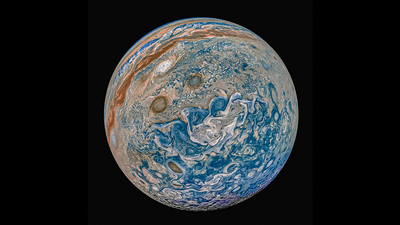


When Galileo Galilei first observed the moons of Jupiter on January 7, 1610, using his homemade telescope, he provided the first evidence humans had of celestial bodies that were not orbiting the Earth.
Though it would take centuries to observe stellar parallax – the final nail in the old Ptolemaic model of the Solar System, where the Sun and the planets orbit the Earth – the discovery showed that at least some objects out there were not in orbit around the Earth, suggesting the rival heliocentric model may be better at explaining the cosmos. Somewhat ironically, and complicating the picture, later discoveries would show that Jupiter itself technically isn't orbiting the Sun at all, but a point outside of it.
In terms of mass, 99.86 percent of the Solar System is the Sun, with all the planets, dwarf planets, moons, comets, and asteroids making up the remaining 0.14 percent. But just as the gravity of the Earth pulls on you, you exert a tiny pull on the Earth, and despite the negligible mass of the planets compared to the Sun, gravity works both ways. Because of this, planets and stars do not orbit around each other, but around a common center known as the "barycenter".
Jupiter makes up around 70 percent of the Solar System's mass when you exclude the Sun, and this is enough that the Jupiter-Sun barycenter lies outside the Sun itself. The same is true of smaller objects, such as the planets, dwarf planets, and their moons. For example, none of Pluto's five moons technically orbit the dwarf planet, while Earth and the Moon orbit a barycenter around 5,000 kilometers (3,100 miles) from the center of the Earth.
"Jupiter is a lot larger than Earth. It has 318 times more mass. As a result, the barycenter of Jupiter and the Sun isn’t in the center of the Sun. It’s actually just outside the Sun's surface!" NASA explains. "Our entire Solar System also has a barycenter. The Sun, Earth, and all of the planets in the Solar System orbit around this barycenter. It is the center of mass of every object in the Solar System combined."
Thanks to the sheer mass of Jupiter and fellow gas giant Saturn, the Solar System barycenter is rarely in the center of the Sun, and often outside of the Sun altogether, as the video below from planetary astronomer and science communicator James O'Donoghue demonstrates.
In short, it won't affect your life too much, but the simplified version that you were taught at school about every planet orbiting the Sun is technically incorrect. We orbit a common barycenter, which is sometimes inside the Sun, but not always. And for Jupiter, the barycenter is just outside of the Sun's surface. When you are that massive, you do not orbit the Sun itself.


