Space and Physics
 PUBLISHED




If asked what proportion of the Solar System’s mass was in the Sun, some people would check a reliable source, while others would roll the dice by asking AI. If forced to guess, however, it’s likely most would get it badly wrong. The truth is that 99.86 percent of the Solar System’s mass is crammed into the Sun.
That means that all the planets, moons, asteroids, and comets combined have a total mass of 0.14 percent, which is about 700 times smaller than the Sun. Yes, we know there are plenty of asteroids still to discover, along with comets lurking in the Oort Cloud and maybe even Planet 9. Those are still unlikely to be enough that, in combination, they could shift the total by even a hundredth of a percent and take the Sun’s share down to 99.85 percent.
Of the remaining mass, not quite 0.10 percent of the total (70 percent of the non-solar mass) is in Jupiter. The other three gas giants have 0.038 percent (about 28 percent of the non-solar mass). Earth is just 0.0003 percent of the total, and is about 0.2 percent of the system’s mass even without the Sun. Venus, Mars, and Mercury have a combined mass almost matching Earth’s. All those millions of asteroids – known and about to be discovered by the Vera Rubin Telescope – and comets don’t register unless you push things out another few decimal points.
Since this is an answer you could get many places online, we wanted to add a bit of value here and consider why there is a high chance this answer surprised you.
The first thing is that almost none of the images you have seen of the Solar System are to scale. Making them to scale in terms of the distances between planets is basically impossible if you want to see anything. If you scaled them to a size visible to the human eye, the distance is massive. Or the planets would be so tiny they'd be microscopic dots.
One of the largest scale models of the Solar System in the world is the 1: 100 million scale World's Largest Virtual Solar System Drive in Australia, with the Sun represented by the dome of the Siding Spring Observatory. Neptune on this model is 133 kilometers (80 miles) away, even if you ignore the decision to thumb a collective nose at the International Astronomical Union and keep Pluto in place. The other is the 1: 20 million scale Sweden Solar System in, yep, Sweden. The Avicii Arena in Stockholm represents the Sun and Neptune is located 229 kilometers (142 miles) away in Söderhamn. (The model technically ends with the Termination Shock, a whopping 950 kilometers [590 miles] away in Kiruna, above the Arctic Circle.)
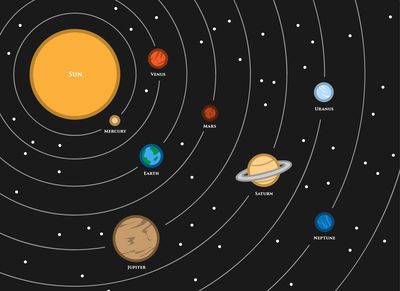
Smaller-scale models exist, such as this one below, but Mercury becomes almost too small to see in them.
Even if we kept the objects to scale and erased the distances between them, scale images of the system make the smaller planets look so tiny they lose their individuality, and moons and asteroids disappear from view.
Consequently, most of the time, images show the Sun with a radius two or three times Jupiter’s, and maybe 10 times Earth’s. The true ratios are 10 and 110.
Moreover, two-dimensional images misrepresent the difference in size, since a (nearly) spherical object’s volume goes with the cube of its radius, but the area in a picture only goes as the radius’s square. High school maths taught us this, but our instincts are still to see an object with 10 times the radius as a hundred times the size of another, not a thousand times.
There is one last reason people may be surprised by these statistics, and it’s one we at IFLScience have to take some responsibility for. One of the more popular articles we have published is one explaining that, technically speaking, Jupiter doesn’t orbit the Sun.
All orbits are around a barycenter, that is the center of mass of the two objects. Jupiter is so massive that the barycenter of the Sun-Jupiter system is just outside the Sun. Less massive planets would have barycenters inside the Sun if considered in isolation. However, Jupiter’s mass moves the barycenter of the Solar System as a whole outside the Sun. Pluto and its moons have a similar dynamic – the barycenter lies outside the dwarf planet.
If you’ve read that article, or others like it, you might suspect Jupiter’s mass is not that much less than the Sun’s, but that is not the case. Their ratio is 1,050 to 1. However, Jupiter is also a long way from the Sun, and the location of the barycenter depends on distance as well as mass.
You might be wondering if this is an unusual feature of our Solar System, or if most stars dominate their planets to a similar extent. The truth is, we don’t fully know, because even after discovering more than 6,000 planets, we don’t know how many are lurking out there. Nevertheless, we do know that most systems with a single star and orbiting planets seem to have broadly similar ratios. That is, the more massive the star, the greater the chance there will be giant planets.
Nevertheless, there are rare exceptions, with very low mass stars being accompanied by massive planets, whose formation remains a mystery we have yet to solve.