Space and Physics
 PUBLISHED


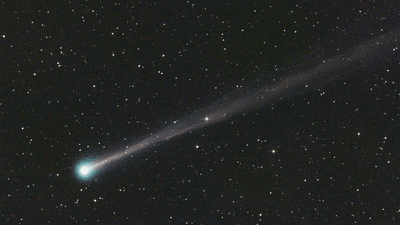


If you're looking for your chance to see a 1 in 170,000-year event, now is your window of opportunity. Comet C/2025 R3 (PANSTARRS) has begun brightening leading up to perihelion – its closest approach to the Sun – and at an apparent magnitude of around 5, it may even be spotted with the naked eye as it brightens further.
C/2025 R3 (PANSTARRS) was first spotted, as the name hints, just last year on September 8. At that point, the comet was around 3.6 astronomical units (AU) from the Sun, with 1 AU being the average Earth-Sun distance. Observations show that it is a long-period comet, likely originating from the Oort cloud, and completing an orbit of the Sun only once every 170,000 years. While those time frames are nothing to stars, and the chunks of ice, rock, and planets that make up the Solar System, to put that in context: the last time this rock made an appearance, humanity had only just begun wearing clothes.
When it was first seen, the object was around magnitude 20, but as it came closer to our star, it has begun to brighten rapidly. In January, it was at magnitude 17, whilst amateur astronomers began to show that it had a coma that was rapidly developing and brightening. By April 8, it had reached magnitude 6.
"At the current rate of brightening the comet could reach 3rd magnitude at perihelion although the small elongation will then make observations in a dark sky impossible," Nick James of the British Astronomical Association explains. "Forward scattering may even enhance that magnitude to some extent so it is definitely worth observing the comet as far into the morning twilight as possible."
The comet will hopefully continue to brighten as it gets closer to perihelion. But the best time to observe it is within the next few days, as by April 20, it will be too close to the Sun in the morning sky for you to see it.
In order to see the comet, you will have to wake up early. But given that the event only comes around once every 170,000 years, that doesn't seem like a very big ask. By getting up at around an hour before dawn, the comet should be above the horizon, and not competing too much with light from our Sun. The comet will be visible in the east, near the Great Square of Pegasus in, you guessed it, the constellation of Pegasus.
The comet should be viewable with binoculars as a fuzzy ball, though a telescope is more ideal as you should be able to see more of the object's structure, including its tail. While Southern Hemisphere viewers will have to wait a while, it should be visible there from late April, hopefully remaining bright and spectacular.