Space and Physics
 PUBLISHED



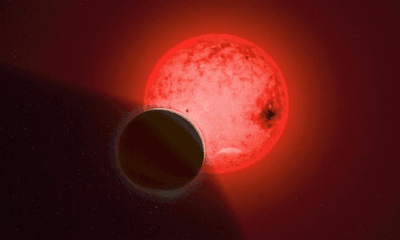


Exoplanet TOI-5205 b has been a head-scratcher since its discovery. It is just over the size of Jupiter and orbits a red dwarf star with a radius only about 4 times as big as its own. How this unusual configuration came to be remains uncertain, and new observations have only added to its peculiarities.
The “forbidden” planet itself is just a tad heavier than Jupiter. Its star is a mere 375 times heavier than that, meaning the planet has about 0.3 percent the mass of its star, the highest among all known planets orbiting red dwarfs.
To confirm the strange planet’s existence, the team followed up NASA’s original Transiting Exoplanet Survey Satellite (TESS). They observed the system with JWST as TOI-5205 b transited in front of its star, so the starlight filtering through the planet’s atmosphere revealed its composition – and it is odd!
Astronomers, to the chagrin of chemists everywhere, define anything that isn’t hydrogen or helium as a “metal”. So stars have metallicity, and they can be metal-rich and metal-poor depending on the proportion of elements they contain other than hydrogen and helium.
Generally, when a stellar system forms, the star hogs most of the hydrogen and helium from the stellar nursery, meaning the planets have a higher metallicity than the star. The surprise here is that, based on these observations, TOI-5205 b has a lower metallicity than its star – something that has never seen before and is obviously on the topsy-turvy side of things.
Clearly, something weird is going on. So the team used sophisticated mathematical modeling to predict the cause of their strange result, and these suggest that the heavier elements are mostly buried deep inside the planet.
“We observed much lower metallicity than our models predicted for the planet’s bulk composition, which is calculated from measurements of a planet’s mass and radius. This suggests that its heavy elements migrated inward during formation and now its interior and atmosphere are not mixing,” said co-author Shubham Kanodia at Carnegie Science in Washington DC, in a statement. “In summary, these results suggest a very carbon-rich, oxygen-poor planetary atmosphere.”
The bulk metallicity of the planet is about 100 times that of the atmosphere alone. Still, TOI-5205 b is, once again, a record-breaker. Its atmosphere has the lowest metallicity of any known gas giant. Even so, it isn’t pure hydrogen and helium; there are a bunch of interesting molecules mixed in, such as methane and hydrogen sulfide. Maybe the whole chemical makeup of this world will help us work out how it came to be.
“These findings have implications for our understanding of the giant planet formation process that occurs early in a star’s lifespan. The planet having a lower metallicity than its own host star makes it stand out among all the giant planets that have been studied to date,” co-author Anjali Piette at the University of Birmingham in the UK, said in a statement.
The findings were published in The Astronomical Journal.