Space and Physics
 PUBLISHED
 1
1



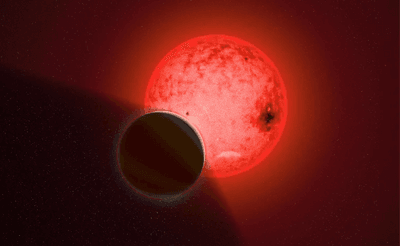


Red dwarfs are the most common type of stars out there. They are smaller and less luminous than our Sun and live for much longer. They are also a great place for planets to form, but not every type of planet: current models suggest that they are an unlikely place for gas giants to form. So imagine the surprise when astronomers found planet TOI-5205b.
The planet is slightly larger and heavier than Jupiter but it orbits a star that is just a bit bigger. At 40 percent of the mass of the Sun, the ratio between the planet's mass versus the star's mass is 0.3 percent. The highest among all known planets orbiting red dwarfs.
“The host star, TOI-5205, is just about four times the size of Jupiter, yet it has somehow managed to form a Jupiter-sized planet, which is quite surprising!” lead author Shubham Kanodia, from the Carnegie Institution for Science, said in a statement.

Planets form in the circumstellar disk, a disk of material that surrounds newborn stars. A planet this size would need to accumulate a rocky core of about 10 Earth masses and subsequently get enough gas to reach something close to 320 times the mass of our planet. And models did not expect this scenario to take place around a red dwarf.
“TOI-5205b’s existence stretches what we know about the disks in which these planets are born,” Kanodia explained. “In the beginning, if there isn’t enough rocky material in the disk to form the initial core, then one cannot form a gas giant planet. And at the end, if the disk evaporates away before the massive core is formed, then one cannot form a gas giant planet. And yet TOI-5205b formed despite these guardrails. Based on our nominal current understanding of planet formation, TOI-5205b should not exist; it is a 'forbidden' planet.”
The planet was first spotted by the Transiting Exoplanet Survey Satellite (TESS). It was then followed up by Kanodia’s team and they were able to confirm it was indeed a planet and work out some of its properties. The planet was discovered with the transit method, by looking at the light of its star. TESS measured a dip in the light as the planet passed in front of it. And it was quite the dip. Seven percent of the light was blocked, one of the largest known in exoplanet transit.
Such an extreme feature bodes well for future observations, including from space observatory JWST.
Details of this discovery are reported in The Astronomical Journal.