Space and Physics
 PUBLISHED




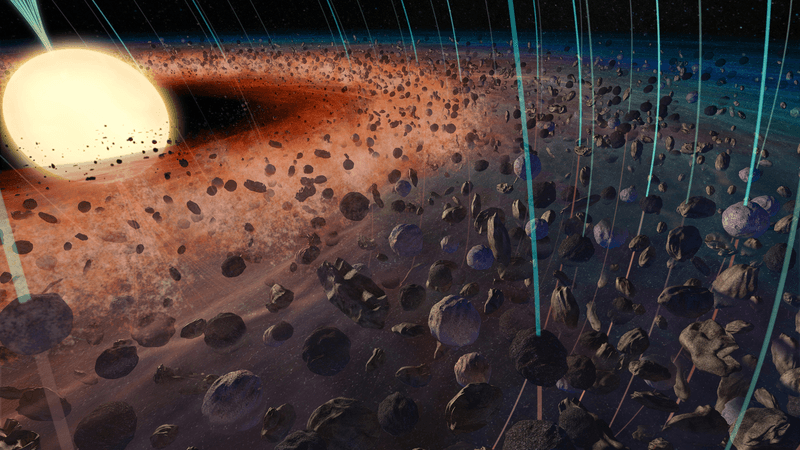
The Solar System is filled with large bodies, between planets, dwarf planets, and large moons. The count goes from dozens to millions if we include asteroids and other space rocks. These fragments of rock suggest that there was a time when there was at least one other (relatively) large rocky world in the Solar System.
There are four canonical rocky planets today: Mercury, Venus, Mars, and Earth. We know that there used to be another large object, nicknamed Theia, in the early Solar System. That Mars-sized body slammed into the Earth to form the Moon. Scientists argue that there must have been another one.
Angrites are rare; only 68 examples are known out of more than 80,000 meteorites in collections. They have little silicon dioxide, which is the main ingredient of Earth, Mars, and rocky worlds.
This led scientists to assume that the parent body of the angrites was a relatively small asteroid, maybe with a radius 200 kilometers (124 miles). Now, they think that this is quite unlikely.
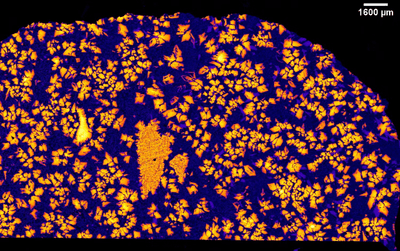
Astronomers have now analyzed the angrite meteorite known as the Northwest Africa (NWA) 12774, discovered in the Sahara Desert, and discovered something quite extraordinary. The presence of clinopyroxene, a mineral crystal found in the Earth’s mantle and crust.
This particular mineral appears to have an incredible aluminum content. Reconstructing the pressure at which it must have been produced, the team found 17.5 kilobars, or about 17.5 times the pressure at the bottom of the Mariana Trench.
The pressure could have only been possible if the parent body was at least 2,000 kilometers (1210 miles) across. Significantly larger than dwarf planet Ceres, the largest body in the Asteroid Belt.
“It’s incredible to think there was once a world this large,” Aaron Bell, an assistant research professor in the Department of Earth Science at CU Boulder, said in a statement. “We only know it existed because a few fragments of it happened to land on Earth. These meteorites preserved evidence of a completely different pathway through which early planets developed.”
The parent body might have been even bigger. Further chemical evidence reveals the presence of crystals that could not have formed too deep within a planet. The balancing act of shallow depths and moderately high pressures gives a possible range of sizes.
The lost planet might have had a radius of 1,800 kilometers (1,118 miles), comparable to the Moon, if not approaching the size of Mars, which is 3,300 kilometers (2,050 miles) in radius. Where this object has gone is unknown. The only evidence is a handful of meteorites.
“There are many meteorites sitting in drawers that haven’t been thoroughly studied, so there were likely more of these protoplanets we don’t know about,” Bell said.
This lost world is truly lost. It might have shattered early on, with only small portions being included in the rocky planets as they formed. Maybe it formed differently, which would explain the distinct composition of angrites.
“The materials that formed the angrite parent body are fundamentally different from the ingredients of Earth and Mars. It points to a distinct and separate evolutionary path in planetary formation in the early history of our Solar System,” Bell said.
The idea of lost and hypothetical planets in the Solar System is an active field of study – and we're not talking about the reclassification of Pluto. Take Vulcan, the hypothetical planet inside the orbit of Mercury, killed by Einstein, or Planet 9.
Other scenarios, both recent and from several years ago, suggest that a much larger planet was kicked out in a case of cosmic billiards. The Solar System is stable for now, but it might not always have been.
The study is published in the journal Earth and Planetary Science Letters.