Space and Physics
 PUBLISHED




Trying to reach one of the most peculiar asteroids in the Solar System – the metallic world Psyche – sometimes requires traveling by convoluted but energy-efficient routes. This is why NASA’s Psyche (the spacecraft) flew by Mars.
On May 15, the Psyche spacecraft reached a distance of about 4,500 kilometers (2,800 miles) from the surface of the Red Planet, traveling at an impressive speed: 19,848 kilometers (12,333 miles) per hour. This flyby was key to placing Psyche on the right route to its namesake asteroid.
From weeks before the actual flyby until the closest approach, the spacecraft took thousands of images as well as testing a variety of instruments on Mars itself. This was good practice for the future.
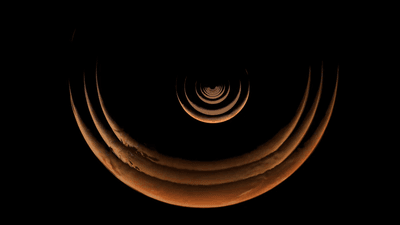
The images were certainly unusual views for Mars, as Psyche was coming from a very high-phase angle. This means that it was coming from its night side, and for this reason, Mars is nothing more than a thin crescent for most of the timelapse.
“The mission’s imager, magnetometer, and gamma-ray and neutron spectrometer teams worked overtime to make full use of this planetary encounter, and all instruments delivered great results,” Lindy Elkins-Tanton, principal investigator for Psyche at the University of California, Berkeley, said in a statement.
“We didn’t anticipate big discoveries, given how extensively the planet has been studied, but we did complement Mars science with the data we collected through Psyche’s unique perspective.”
Still, the instruments performed as expected, confirming expectations about the magnetic behavior of Mars, as well as particle production due to the bombardment of cosmic rays that planets experience. The mission team seems very happy about it.
“The imager performed brilliantly, delivering some rarely seen views of the Red Planet,” said Jim Bell, the Psyche imager instrument lead at Arizona State University in Tempe.
“Besides the obvious beauty of the photos, we were also able to fully test its calibration and sensitivity to scattered light, including picking out the Martian moons Phobos and Deimos from very far away as a part of a practice for the satellite search that we’ll use at the asteroid Psyche to look for any moonlets there.”
While the science instrument tests were important, the crucial thing was that the flyby went smoothly. Spacecraft use planets to get a speed boost and change their trajectory – known as a gravity assist – and this went off without a hitch.
“This gravity assist was years in the making, and the navigation team nailed it – Psyche flew by Mars on exactly the trajectory we needed to set us on a path to rendezvous with the asteroid in the summer of 2029,” said Bob Mase, Psyche’s project manager at NASA’s Jet Propulsion Laboratory in Southern California.
“The spacecraft is in great shape, and we’re on schedule to resume sustained thrusting with the solar-electric propulsion system later this fall.”