Space and Physics
 PUBLISHED





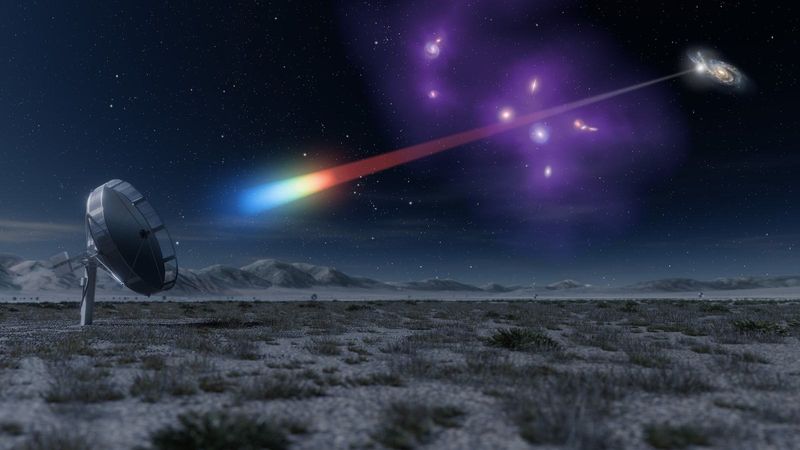
There are a lot of particles that come from space and rain down on us, every second of every day. If we include neutrinos, we think trillions of them are passing through your body right now, but if we just focus on cosmic rays from beyond the Solar System, we still get a fair amount hitting us. Researchers have now measured record-breaking particles coming to Earth.
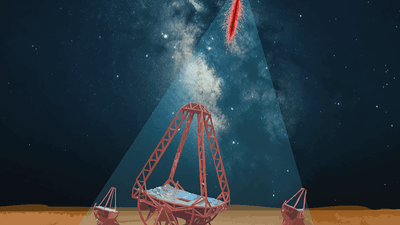
Using the H.E.S.S. Observatory located in Namibia, researchers detected electrons and their antimatter counterparts, positrons, slamming into the atmosphere with an energy of over 40 teraelectronvolts or TeV. That is over six times the energy that particles in the Large Hadron Collider are accelerated to.
The findings are also exciting for another reason. Not only are these the most energetic cosmic ray electrons and positrons (CRe) ever detected, but the data suggests that these particles could not have formed too far away from Earth. Whatever is accelerating these particles is near, galactically speaking.
“This is an important result, as we can conclude that the measured CRe most likely originate from very few sources in the vicinity of our own Solar System, up to a maximum of a few 1,000 light years away, a very small distance compared to the size of our Galaxy,” Kathrin Egberts from the University of Potsdam, one of the corresponding authors of the study, said in a statement.
The most energetic cosmic rays are accelerated in extremely energetic events, like around supermassive black holes. But those are millions of light-years away. Objects with prodigious magnetic fields like pulsars or another type of supernova remnant might be the culprit here. The closest pulsar is 510 light-years away.
“We were able to put severe constrains on the origin of these cosmic electrons with our detailed analysis for the first time”, added Professor Werner Hofmann from the Max-Planck-Institut für Kernphysik, co-author of the study.
“The very low fluxes at larger TeV limit the possibilities of space-based missions to compete with this measurement. Thereby, our measurement does not only provide data in a crucial and previously unexplored energy range, impacting our understanding of the local neighbourhood, but it is also likely to remain a benchmark for the coming years,” Mathieu de Naurois, CNRS Researcher from the Laboratoire Leprince-Ringuet, added.
When gamma rays or high-energy cosmic rays hit the atmosphere, they can generate a lot of secondary particles that move faster than light in air (not faster than light in a vacuum!). This process generates a light called Cherenkov radiation. H.E.S.S. mainly studies gamma rays hitting the atmosphere but it can also measure the Cherenkov radiation produced by high-energy cosmic rays moving through the atmosphere. That’s how these record-breaking particles were spotted.
A paper describing the results is published in the journal Physical Review Letters.