Space and Physics
 PUBLISHED



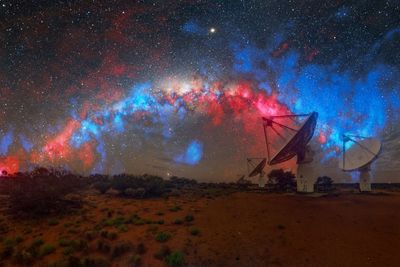


Radio astronomers have released the largest-ever map of the magnetic fields between stars, as well as the ones that stretch between galaxies. The map, five times larger than all previous efforts combined, will help uncover the role of magnetism in the formation of cosmic structures.
Electromagnetism is a much stronger force than gravity. That said, its influence at the scale of the universe is more subtle because, unlike gravity, electric charges can cancel one another out. This means it's usually easier to see the effect of gravity on the cosmos than electromagnetism.
That’s where the Polarisation Sky Survey of the Universe's Magnetism (POSSUM) collaboration comes in. Using the advanced capabilities of the ASKAP radio telescope in Western Australia, they were able to map cosmic magnetic fields like never before.
“For the first time, we can investigate fine details of the material between nearby stars and study a huge number of distant galaxies,” Alec Thomson, lead researcher and commissioning scientist with the SKA Observatory, which is building the successor to ASKAP, said in a statement.
The map will also allow researchers to better understand how energy is distributed across the universe.
As light passes through magnetic fields, it twists in specific directions and becomes polarized. Polarized light has a number of interesting use cases, including in 3D cinema, where the glasses allow only certain types of polarized light through each lens, providing slightly different images for each eye and creating the illusion of volume.
ASKAP can measure the polarization of radio waves as they travel through those magnetic fields, revealing them in the process. The Rapid ASKAP Continuum Survey (RACS) the fastest and largest radio sky survey ever made, and the resulting map is called SPICE-RACS, with SPICE standing for Spectra and Polarisation InCutouts of Extragalactic sources. Astronomers love a punny backronym.
“We collected rotation measures from every galaxy detected in RACS – nearly 4 million galaxies – and reprocessed this original
data from ASKAP to retrieve the full picture,” Thomson added.
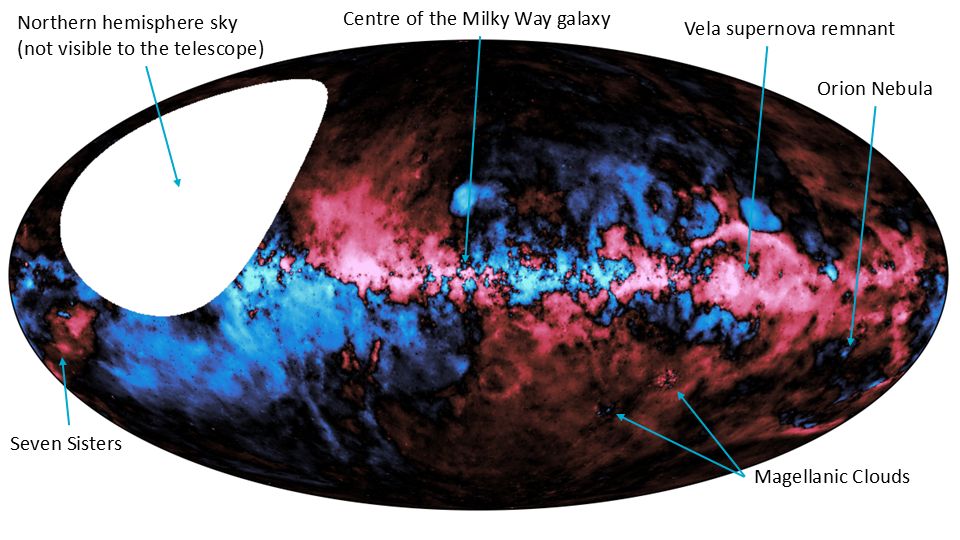
The work represents a major leap forward when it comes to cosmic magnetic fields. By having the distribution and intensity mapped out, researchers can now answer some crucial questions about the influence of magnetism on the structure of the universe.
“With the information we now have on magnetic fields throughout the universe, we can study things like how magnetic fields affect the galactic-scale interaction of our own Milky Way and its neighbours, the Magellanic Clouds,” SKAO's Chief Scientist Naomi McClure-Griffiths explained.
“We can even potentially find the answer to questions like when did magnetic fields first appear in the universe? We had once thought it would be impossible to answer these questions. I’m excited to say that is no longer the case.”
ASKAP's successor will be split across two observatories, SKA-Low and SKA-Mid, which are currently being built in South Africa and Australia. SKA-Low is under construction in the traditional lands of the Wajarri Aboriginal people in Western Australia.
SKA-Low looks different from what one expects of a radio observatory. There isn't a single large radio dish but a forest of 130,000 Christmas tree-shaped antennas that will observe the whole sky. First observations have been taken, but the observatory won’t be fully complete until 2030. According to the researchers working on the project, the science potential is enormous.
“It covers everything from how the universe began to how galaxies form and evolve,” Wendy Williams, a project scientist working for SKAO, told IFLScience. “What I’m particularly excited about is the ability to map large areas of the sky with the instruments, both [SKA-]Low and Mid; map out how many galaxies are there, how many supermassive black holes are there, and see how these processes evolve and change with time.”
In the meantime, scientists will have plenty to do with the SPICE-RACS map, and the data is freely available from the database of CSIRO, the Australian science agency.
“Our data is accessible to anyone, whether it be for something unique in their own work or to replicate something tested already – an important part of the scientific process,” said CSIRO astronomer and ASKAP Data Specialist Tim Galvin
A paper detailing the extraordinary new map has been accepted for publication by the journal Publications of the Astronomical Society of Australia.