Space and Physics
 PUBLISHED



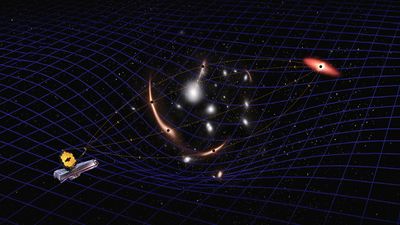


An international team of astronomers has measured the mass of a dormant supermassive black hole in a galaxy over 10 billion light-years away. This is the farthest measurement of this kind ever achieved, 15 times the previous record.
It is difficult to weigh a black hole; you can’t put it on a scale. We have a few techniques to work out their mass based on the brightness of the light created around them, but that can't work for quiet black holes. Those can only be measured thanks to stellar dynamics.
This approach requires the measurement of the motion of the stars closest to the supermassive black hole. For this reason, it usually works only for very nearby galaxies, for which these stars can be resolved. Now the combination of two techniques has allowed the method to be applied to a galaxy so far away that the light reaching us now started its journey just 3 billion years after the Big Bang.
The first development is the sharp eye of JWST. The space telescope can see farther and better than any other in the infrared part of the spectrum. The second is gravitational lensing. The light of the galaxy in question, MRG-M0138, is warped and magnified by a foreground galaxy cluster. This has brought the core of this distant object into more detailed focus.
“These two techniques have enabled us to get down to an angular resolution that's equivalent to looking at a coin on the surface of the moon,” senior author Richard Ellis at University College London told IFLScience.
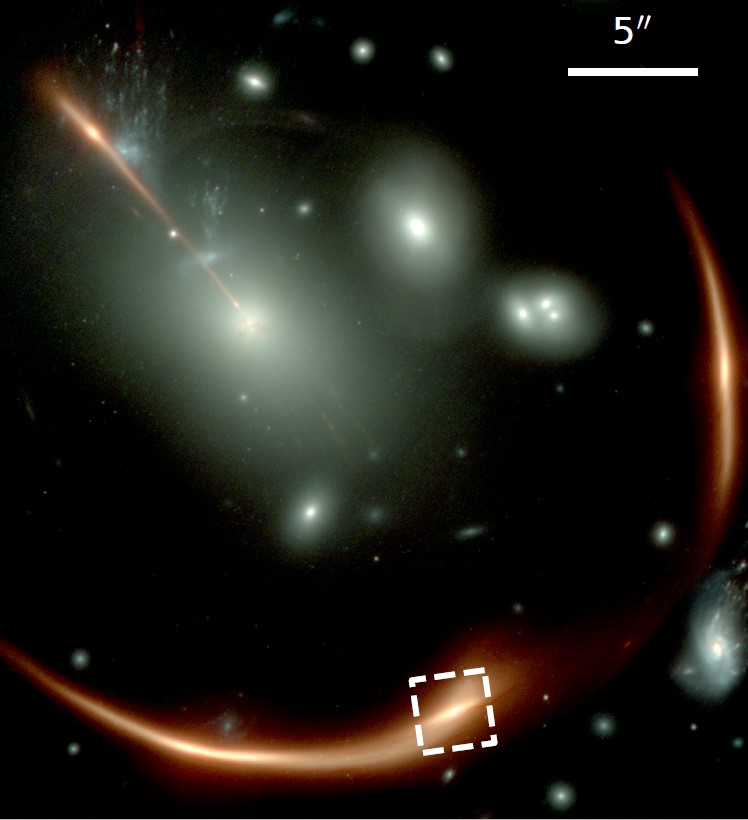
The work, led by his former student Andrew Newman at Carnegie Science, provides an important approach to understanding a particularly crucial period in galaxy evolution.
Galaxies today can broadly be divided between active and quiescent. To understand the origin of the quiescent galaxies, sometimes called "red and dead," one might reasonably start around the epoch known as cosmic noon. This is the peak of star formation in the universe and a time when supermassive black holes started to get active as gas was funneled towards them during galactic collisions.
The route is now open for something that was completely impossible before.
Richard Ellis
An active supermassive black hole, which becomes something called a quasar, can generate powerful winds that heat up and push out the gas required to form stars. So before going dormant, a supermassive black hole might completely wipe out its galaxy's ability to stay young and active.
“It looks like this black hole must have been responsible, you know, for getting rid of the gas about 200 to 300 (maybe 400) million years earlier,” Ellis explained.
The black hole is large, 6 billion times the mass of the Sun. That’s over 1,000 times the mass of Sagittarius A*, the supermassive black hole at the center of the Milky Way. The stars around it are orbiting at 400 kilometers (250 miles) per second.
The team intends to study similar objects using the same approach. Such stellar dynamics measurements using JWST and gravitational lensing should allow us to understand how galaxies stop being active and the role black holes play in that.
“It opens the door for finding more objects of this kind, now that we know it's technically possible, and therefore we can do a census of the galaxies that are red and dead, that don't have young stars anymore, and we can see how recently they quench their stars and whether there's a black hole responsible for that quenching,” Ellis explained.
“The route is now open for something that was completely impossible before.”
The ongoing Euclid mission should also find more of these gravitationally lensed objects, allowing scientists to build up a population of candidate objects to study and providing a window into a very important moment in galaxy evolution.
The findings from this work were published in the journal Science.