Space and Physics
 PUBLISHED
 1
1


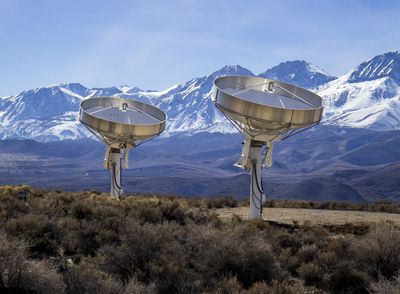


The next generation of astronomical observatories continues to expand. The Deep Synoptic Array (DSA) has now passed its final design review with Schmidt Sciences – the funder of this project – and it will begin construction soon in Spring Valley, Nevada, under Caltech supervision. Once completed, it will be a truly revolutionary instrument, a radio observatory like never before.
It will be the most sensitive radio observatory ever built, survey the sky 100 times faster than any other radio telescope, and produce radio images of the highest quality ever. And it is these radio images, which will be immediately available to everyone, that actually make the DSA a radio camera and make the whole system possible.
DSA will feature 1,650 steerable 6.15-meter (20-foot) antennas. They have special indium phosphide transistors that allow them to operate with high sensitivity at room temperature. Each antenna delivers an incredible amount of data. Together, the system would deliver raw data equivalent to the current US internet traffic.
Fortunately, the setup has dedicated graphics processing units that don't require intensive data processing after the observations. Basically, it will deliver real-time images of the "radio sky."
"Without the radio camera, we would have to store 100 exabytes of data [100 billion gigabytes] to complete our survey," Gregg Hallinan, principal investigator of DSA, professor of astronomy at Caltech, and director of Caltech's Owens Valley Radio Observatory (OVRO), said in a statement. "This would require 5 million hard drives in a multi-billion-dollar facility the size of multiple football fields. The radio camera solves this problem."
The radio images will be an incredible tool to study a variety of objects and provide answers about their nature. The observatory will study fast radio bursts, mysterious and very brief emissions of radio waves that come from beyond the galaxy.
The observatory will also study radio staples such as black holes and pulsars, as well as help probe the mysteries of collisions between neutron stars and maybe the universe itself.
"Radio astronomy is about to go from sketch to photograph," added Vikram Ravi, the co-principal investigator of the DSA and a professor of astronomy at Caltech. "The DSA is looking at a far larger volume of the universe far more often than any other telescope. I'm excited for all the discoveries we know we will make, and the ones we don't expect."
The cherry on top of this revolutionary ability is the fact that all the radio images will be available to the public freely without any proprietary period. The DSA and the three other Schmidt Science observatories being built – including the first private space telescope – will provide a new way for many to access the cutting edge of astronomy.
“We're building it for you, for the scientists sitting somewhere without access to telescopes,” astronomer Arpita Roy, director of astrophysics and space at Schmidt Sciences, told IFLScience previously.
“My message is they should start thinking about how best to use these resources and to get ready, because it's coming up pretty quickly."
First light for DSA is expected in 2029.