Space and Physics
 PUBLISHED




What you'll discover in this article
- Researchers have discovered that a small fraction of white dwarfs are colorful and not white.
- It has to do with how extraneous elements in their atmospheres change the spectrum of their light.
- "Do these very strange-looking features actually affect what we would see if we could visit these stars up close?” lead author Dr Mark Hollands wondered. The answer appears to be yes!
The universal palette of stars and stellar objects has just gained a few more colors. The discovery comes from an interesting investigation into what white dwarfs actually end up looking like due to the stuff in their atmospheres.
Stars star by fusing hydrogen in their core. While they are doing that, they are said to be on the main sequence. Main sequence stars have a narrow range of colors that scale with their temperature.
Seeing them up close, all these stars would be bright, but in terms of color, you go from a pale orange/red, to the white of the Sun, to the pale blue of the hottest stars. The spectrum – the rainbow – of their light is shifted by temperature alone.
Stars like our Sun and heavier ones will eventually stop fusing hydrogen. They will contract, the core will get hot enough to fuse helium, and they'll swell up into red giants. Eventually, the helium too will run out. The smaller of these stars, like our own, will shed their outer layer, and the core will contract into a white dwarf.
As an astronomer, just like anyone else, you wonder what these things actually look like.
Dr Mark Hollands
As the name suggests, these objects are white. They shine extremely brightly at first. Their luminosity doesn’t come from nuclear processes but from the intense heat trapped inside as they formed. After all, you are packing something with half the mass of the Sun into a sphere as big as Earth!
At the same time, these objects can become polluted with a lot of different elements. These affect the spectra of the objects, in some cases significantly. And this raised an important question.
“Some of the complicated features that we see in the spectra occur at the same wavelengths that our eyes are sensitive to,” lead author Dr Mark Hollands, from the University of Warwick, told IFLScience.
“It was always a question I had very early on in my career: I wonder what these stars would look like if you could actually see them. Do these very strange-looking features actually affect what we would see if we could visit these stars up close?”
Not all white dwarfs are white
The new work showcases that it is possible for some white dwarfs to not appear white at all.
The team looked at the 151 white dwarfs that are within 20 parsecs (about 65 light-years) from Earth. Only a handful had weird colors, and the median color for most of them was the white produced by electronic displays.
They estimated that peculiarities are only found in one in 30 white dwarfs in the galaxy. For some stars, this is a matter of temperature; a cooling white dwarf will shift to redder colors like cooler stars. But for several others, the reason for the odd colors appears to be pollution.
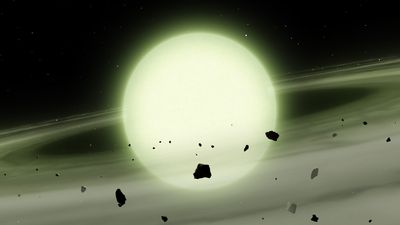
The red giant phase can be devastating for a star system. It is unlikely that our own will survive the transformation of the Sun into a white dwarf. The cosmic material that is released can turn into a new planet, as we recently saw in a different study, and it also falls onto the white dwarf.
These objects should be just hydrogen and helium, so the presence of other elements is a hallmark that something is falling onto the former star – and they can also do something else too.
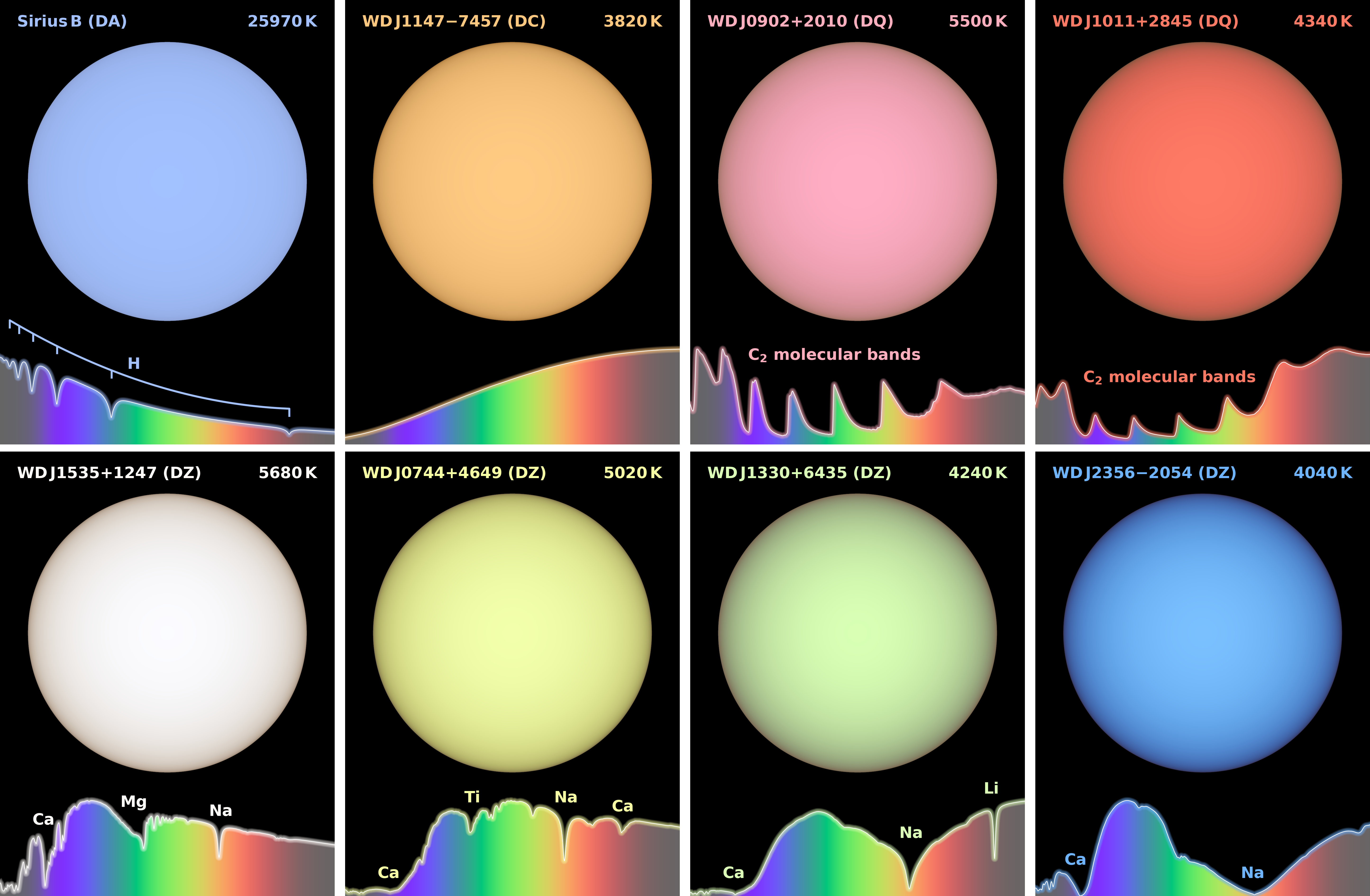
“These chemical elements can distort the spectra of these stars in such a profound way that our eyes would be sensitive to it,” Dr Hollands told IFLScience.
Colorful exceptions to pale rules
This is not the case for all white dwarfs, but as is highlighted in this work, there are truly some spectacular examples. The most exciting one is WD J1330+6435, which – thanks to the sodium in its atmosphere absorbing a good chunk of orange, red, and yellow light – appears a ghostly chartreuse green.
You wonder what it would be like if you could go there. Maybe this is the closest we can do, at least now.
Dr Mark Hollands
There are also stars whose color is determined by internal processes. White dwarfs that have cooled down can develop a convection zone that lifts some carbon molecules into the outer layers. These absorb light in bands, and the peculiar combination can give rise to pastel pink or even salmon-pink white dwarfs.
“As an astronomer, just like anyone else, you wonder what these things actually look like,” Dr Hollands told IFLScience.
“You study them and you try to understand the physics, but you can't go there. You wonder what it would be like if you could go there. Maybe this is the closest we can do, at least now.”
Physics is not always discovering the unknown; it can also bring the cosmic to what our senses can understand. And it turns out that pink and green stars are now a thing.
The study is published in the journal RAS Techniques and Instruments (RASTI).


 1
1