Space and Physics
 PUBLISHED
 1
1



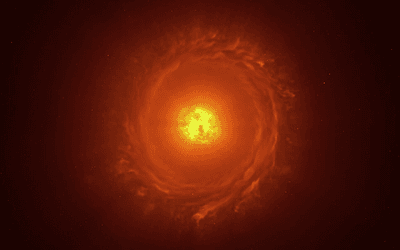


One of the largest stars close enough for us to estimate its size, WOH G64, appears to have gone from red to yellow in 2013-14, indicating a temperature rise of about 1,000°C (1,800°F). Last year it faded significantly in brightness. Astronomers think they know what happened, but admit they are uncertain whether we’re going to get an explosion in one of our nearest galactic neighbors.
The Milky Way galaxy contains some enormous stars like NML Cygni and RW Cephei, which are more than twice as wide as Betelgeuse, which in turn is around 700 times wider than the Sun (with some uncertainty). However, if you want stars so big the term supergiant is inadequate, and hypergiant is sometimes used instead, the Large Magellanic Cloud (LMC) is the place to look. The LMC is less than a tenth the mass of the Milky Way, but its relative lack of metals creates a much larger population of truly enormous stars.
Measuring the size of objects that are 160,000 light years is challenging, but WOH G64 is a strong contender for the largest, brightest, and most massive star in the LMC, estimated to have a radius 1,540 times that of the Sun. Since the more massive a star is, the faster it burns through its fuel and, at this size, it is set to become a supernova – or collapses directly to a black hole – this is a star to watch. Comparing recent images of WOH G64 with those from the 1980s show its color has shifted in that time from red to yellow. Much more recently, it dimmed dramatically.
Stars are colored by their temperature, which determines the wavelength at which they emit most light, so this color change apparently reflects a steep rise in temperature. Scientists reporting these observations, however, think that the hypergiant star has been yellow all along, and therefore hotter than most stars at this late stage of life. It is just shrouded by dust that makes it look cooler. The shift to a yellow appearance was probably the result of us temporarily getting a less-obstructed view.
In the 1980s, WOH G64’s deep red color led to it being considered one of the coolest supergiant stars we knew of. It was also found to be shedding material through its stellar wind at a rate of more than one Sun’s mass every 10,000 years, and it is surrounded by an envelope of gas equivalent to 3-9 solar masses. Further out are shells of dust WOH G64 has previously expelled.
WOH G64 was also found to pulse with a period of a little over two years, its brightness varying by 1.5-2 magnitudes. That’s not unusual behavior for a supergiant star towards the end of its life, but it complicates observations. A 2-magnitude fading observed in 2025 is beyond this normal variation, but it’s too soon to say whether it’s anything bigger than Betelgeuse’s dusty sneeze.
A team led by Dr Gonzalo Muñoz-Sanchez of the National Observatory of Athens put these observations together to conclude WOH G64 is probably a symbiotic star system. Like the pairs of stars that produce novae, symbiotic stars involve a cool star that has puffed up in its giant or supergiant phase so that it has a very low density. Its companion star is less massive, but much denser, allowing it to pull material away from the edges of the giant star. In novae, the companion is a white dwarf, but in a symbiotic star system it can also be a main sequence star.
The surrounding gas means we can’t currently separate the two stars, despite the fact they are probably on a mutual orbit lasting four years. Consequently, we don’t know how much of the light we see is coming from the supergiant and how much from its companion. More importantly, the authors can’t tell if the changing color is a product of changes in the hypergiant alone, or a result of shifting interactions between the two stars.
In the second case, the stars’ orbits would be decaying, releasing energy that creates pulses every few decades. Alternatively, the hypergiant could have erupted, as giant stars do late in life, throwing off its outer layers, which are now cooling as they expand away from the star, leading to a slow return to its red color.
“We cannot predict the future of WOH G64 due to the poorly constrained physical and orbital parameters, and because we do not know whether single-stellar physics or binary interactions drive the system evolution,” the authors write.
However, the authors also note that type II supernovae are usually surrounded by circumstellar material. One explanation for this is that these stars throw off a lot of material less than a year before they explode. With 11 years having passed since WOH G64’s suspected eruption, it is clearly not following that script precisely.
Nevertheless, the authors think the larger star in the WOH G64 system is a strong supernova candidate, even if we don’t know the timing. If it does explode, what we see will be strongly influenced by the surrounding gas, which they think probably forms a torus shape, allowing its eventual explosion to expand unobstructed at the poles, while ploughing into dust around the equator.
On the other hand, they think it is also possible WOH G64’s primary star will undergo direct collapse to a black hole, something we may have observed recently for the first time, or merge with its companion. The merging would be a mighty feat, given the proposed distance between them, but would only delay the inevitable explosion/collapse.
In the event of a supernova explosion, professional astronomers, and southern hemisphere amateurs, are in for a treat. The last supernova visible to the naked eye, 1987a, was also in the LMC, and that was from a star built on a much smaller scale than WOH G64’s primary.
The study is published in Nature Astronomy.