Space and Physics
 PUBLISHED


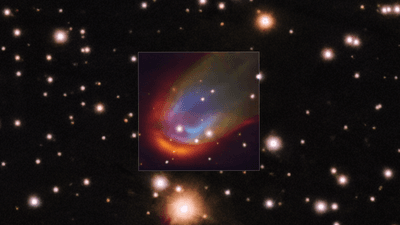


A white dwarf is creating a shockwave as it travels through the interstellar medium. Similar shockwaves are sometimes seen as the result of outflows from stars, but the reasons we know this happens in other cases don’t apply here, so astronomers are unsure how this could be taking place.
Most stars orbit the galactic center, and their travels take them through the interstellar medium. When a star has a powerful stellar wind, the outflowing material collides with that medium, creating a bow shock, a type of shockwave that curves like the wave around a boat’s bow.
Consequently, at first sight, the image collected by the European Southern Observatory’s Very Large Telescope (VLT) of RXJ0528+2838 doesn’t look all that unusual, even if many people may find the mix of colors unusually aesthetic. However, as a white dwarf that long ago stopped fusing elements, a stellar wind from RXJ0528+2838 would be like a corpse exhaling. Although white dwarfs do sometimes contribute to bow shocks in combination with companion main sequence stars, these rely on conditions that don’t seem to apply here, suggesting something new is going on.
“We found something never seen before and, more importantly, entirely unexpected,” said Simone Scaringi, associate professor at Durham University, in a statement. “Our observations reveal a powerful outflow that, according to our current understanding, shouldn’t be there,” added Krystian Iłkiewicz, a postdoctoral researcher at the Nicolaus Copernicus Astronomical Center.
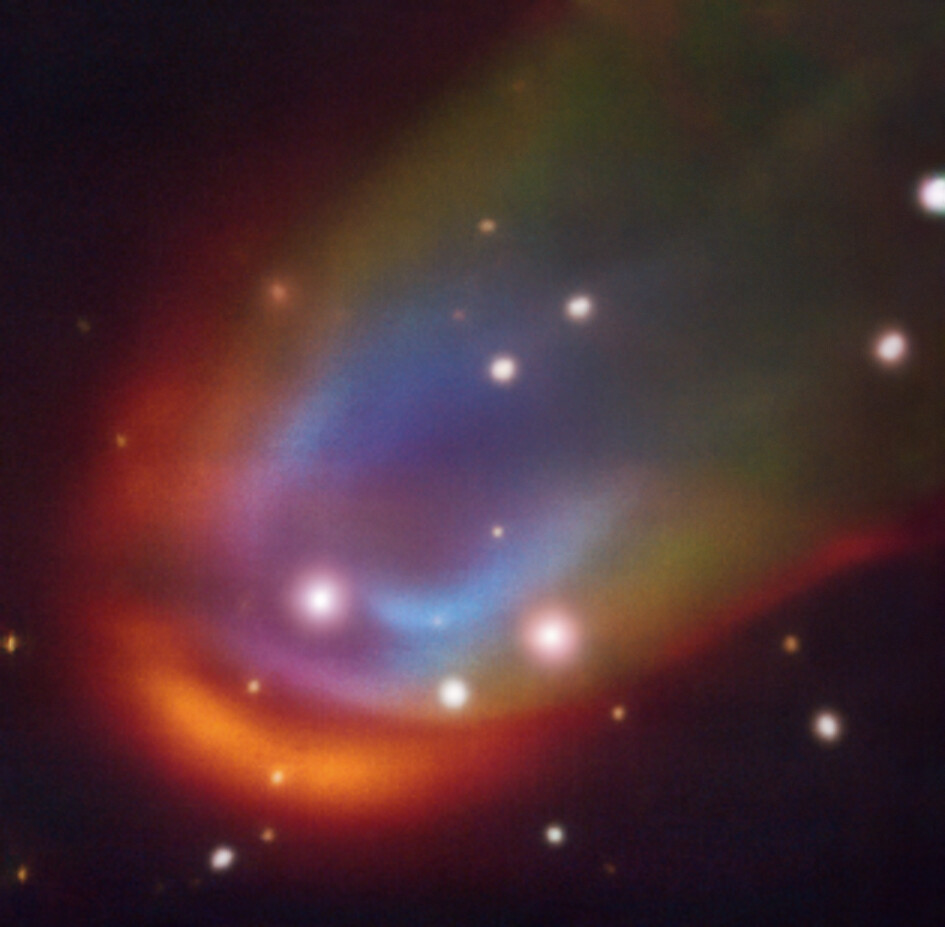
When white dwarfs and main sequence stars orbit close to each other, the dead star can capture material from the living, leading to temporary resurrections. These take the form of brief explosions that produce novae, such as the one we’re waiting for from T Coronae Borealis. Before the gas drawn from the companion star settles on the white dwarf, it creates a disk, some of which is expelled from the system, which can sometimes create a similar bow shock.
However, no such disk can be seen for RXJ0528+2838, despite the fact that at 730 light-years away, it’s closer than most systems where we do see such disks.
“The surprise that a supposedly quiet, discless system could drive such a spectacular nebula was one of those rare ‘wow’ moments,” Scaringi said.
Astronomers using the Isaac Newton Telescope in Spain had observed hints of a nebula around RXJ0528+2838, but were unsure if the white dwarf was the source, or the glow just happened to be in the same direction. The enormous resolving power of the VLT settled that, but left the question of what is causing the outflow. Moreover, Scaringi and co-authors were able to tell from the images that RXJ0528+2838 has been expelling material for at least 1,000 years.
Sometimes white dwarfs’ companion stars produce the stellar wind to create bow shocks around both, but this companion isn’t big enough for that.
The authors also rule out the possibility that the bow shock is the product of an old nova explosion, noting that it’s the wrong shape. Moreover, at this distance, a nova would be visible to the naked eye, yet there are no historical records of one at this spot in the sky.
As so often in physics, when something unexpected comes up, the team behind the observations thinks magnets are responsible, specifically RXJ0528+2838’s magnetic field, which is known to be unusually strong. They think the field is channeling the material from the companion straight onto the white dwarf, rather than taking the long way round via a disk. The energy created by the material landing on the star causes some of it to be thrown off with great force.
Even this explanation is incomplete, however, as it’s only compatible with a few hundred years of outflow, not a full millennium.
“Our finding shows that even without a disc, these systems can drive powerful outflows, revealing a mechanism we do not yet understand. This discovery challenges the standard picture of how matter moves and interacts in these extreme binary systems,” Ilkiewicz said.
Consequently, more work will be required to fully explain the observations, which means we will need more images of this rainbow nebula, something even those who can’t contribute to the research can enjoy.
The study is published in Nature Astronomy.