Space and Physics
 PUBLISHED
 3
3


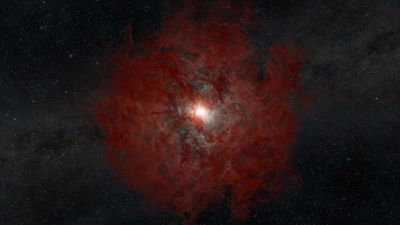


Astronomers combing through years of images collected by the NEOWISE mission have found the clearest known evidence of a star converting directly to a black hole, without passing through the supernova stage. This process has been proposed for some time, and hints of past examples have been found, but now it seems the process was occurring under the noses of everyone with a telescope.
Once a subject of pure theory, stellar-mass black holes have been found to be common since the discovery of the first in 1973. We know that supernovae leave either black holes or neutron stars behind, depending on the mass and composition of the former star, but doubts have grown that this accounts for the entire stellar black hole population. Modeling suggests that when collapsing some stars, neutrinos are not able to trigger a supernova, instead creating a direct collapse to a black hole. However, finding an example has proven difficult.
Although NEOWISE’s primary role was to search for asteroids and comets, it also captured images of the Andromeda Galaxy. A team led by Professor Kishalay De of Columbia University reviewed these images and noticed something unprecedented. Starting in 2014, a massive star, once one of the most luminous in Andromeda, brightened in the infrared part of the spectrum, and stayed that way for a remarkable two years. It then faded rapidly to nothing in visible light, appearing to vanish. Here, the team argues, is the evidence astronomers have been seeking.
“This has probably been the most surprising discovery of my life,” De said in a statement. “The evidence of the disappearance of the star was lying in public archival data and nobody noticed for years until we picked it out.”
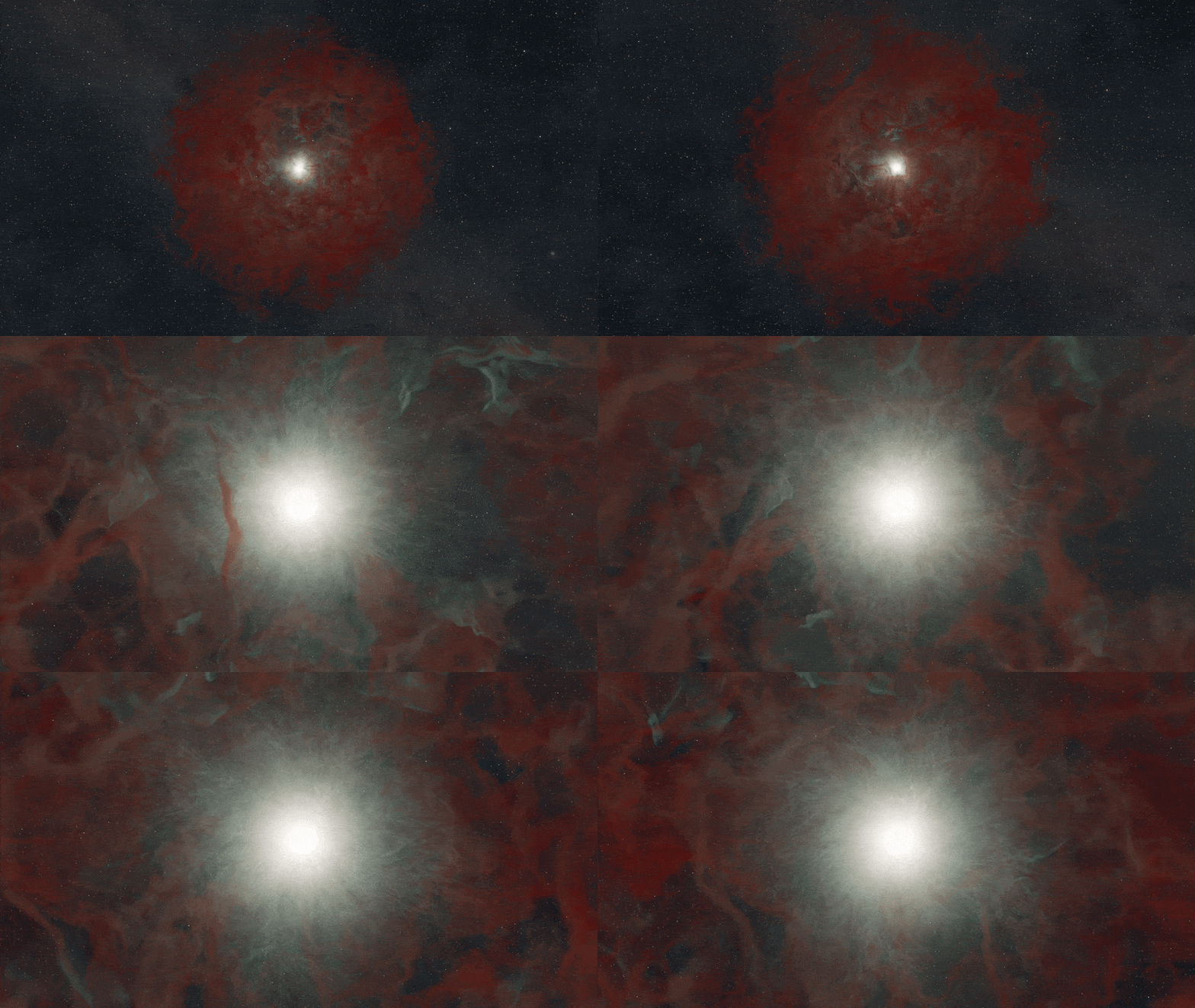
Thrilling as this is, it must come with a fair level of frustration. If anyone had noticed these events at the time, telescopes across the electromagnetic spectrum would have observed the event intently. After all, Andromeda is the nearest large galaxy to our own, visible to the naked eye under dark skies. Now, even Hubble can barely detect the afterglow of this event. Instead, NEOWISE took images only every six months, leaving the time between a mystery.
The star in question has been named M31-2014-DS1, although there’s probably a catchier secret nickname. Pre-collapse images indicate it was initially 13 times the Sun’s mass, well within the typical supernova range, but had put out such extreme stellar winds that it was down to just five solar masses when the infrared brightening started.
“The dramatic and sustained fading of this star is very unusual, and suggests a supernova failed to occur, leading to the collapse of the star’s core directly into a black hole,” De said. “Stars with this mass have long been assumed to always explode as supernovae. The fact that it didn’t suggests that stars with the same mass may or may not successfully explode, possibly due to how gravity, gas pressure, and powerful shock waves interact in chaotic ways with each other inside the dying star.”
So much for everyone waiting for Betelgeuse and other late-stage supergiant stars to do the right thing and give us a fireworks show.
Modeling led by Dr Andrea Antoni of the Flatiron Institute suggests convection is key to the processes that cause a collapsing star to throw off dust, hiding the accretion disk of gas falling into the black hole.
We might already have another case to study. In 2010, a supergiant star disappeared in what has been considered a possible case of direct collapse. However, that was in NGC 6946, which is 22 million light-years away, 10 times as distant as Andromeda, and we didn’t get nearly as clear a view.
Other evidence for direct collapse, besides theoretical modeling, has come in the form of the discovery of black holes in complex star systems that would have been blown apart by a supernova but survived an event like this.
Some astronomers thought the process would be like turning off a light, making it difficult to find such events unless a particularly visible star vanished. However, in the 1970s, models predicted direct collapse would be accompanied by an infrared glow – not as bright as a supernova even at the relevant wavelengths, but still detectable in nearby galaxies. This is because supergiant stars throw off a lot of dust in their later years – as Betelgeuse famously did. The energy emitted by gas falling into the black hole would heat the surrounding dust, making it radiate in the infrared.
That inspired De and co-authors to search nearby galaxies and the Milky Way for signs of dramatic infrared brightening. After finding M31-2014-DS1’s 2014-2017 behavior, closer investigation found it matched predictions perfectly.
Some astronomers remain unconvinced, however. They responded to a preprint of De’s work with one of their own that argues a merger between two stars could also explain what has been seen.
“Unlike finding supernovae, which is easy because the supernova outshines its entire galaxy for a few weeks, finding individual stars that disappear without producing an explosion is remarkably difficult,” De said. “It comes as a shock to know that a massive star basically disappeared (and died) without an explosion and nobody noticed it for more than five years.”
Only one supernova has been recorded in the Andromeda galaxy, reported in 1885. M31-2014-DS1’s behavior, only detectable with instruments that have not been around long, suggests that either we got lucky in witnessing it, or direct collapse is actually the more common way to make black holes.
Despite missing the opportunity to view the most dramatic stage of the event, we’re not dependent on NEOWISE’s archive alone. “This is just the beginning of the story,” De said in a different statement, explaining that the surrounding dust will radiate light that “Is going to be visible for decades at the sensitivity level of telescopes like the JWST, because it’s going to continue to fade very slowly. And this may end up being a benchmark for understanding how stellar black holes form in the universe.”
“We've known that black holes must come from stars. With these two new events, we're getting to watch it happen, and are learning a huge amount about how that process works along the way,” said Harvard’s Dr Morgan MacLeod.
The study is published in Science.