Space and Physics
 PUBLISHED
 1
1



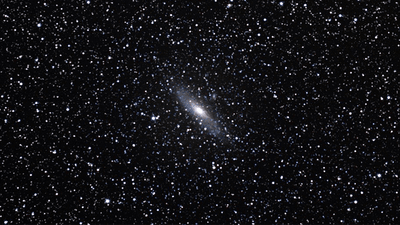


Two new studies have taken a look at an unusual event in Andromeda, the closest major galaxy to the Milky Way, where a giant star has disappeared without any of the usual fanfare.
Stars are generally pretty reliable. With lifespans of billions of years, you can expect to look at one and return to it a few weeks, months, or even years later to find it has roughly the same brightness and other characteristics as last time. Stars may dim like Betelgeuse or explode as supernovae before collapsing into black holes or neutron stars, but generally they don't simply vanish from view.
But this is the universe, with billions of stars out there to observe, and sometimes it doesn't work like that.
In 2014, star M31-2014-DS1 – a yellow supergiant in the Andromeda galaxy that is around 12 to 13 times the mass of our Sun – was seen to grow brighter. Between 2014 and 2018, however, it disappeared from view. The video below covers a similar disappearing act of a different star in 2009.
One possible explanation, which has been tentatively supported by evidence from one of the new studies using data from JWST, is that stars of a sufficient mass can undergo collapse into a black hole without going supernova – they turn directly into a black hole, without the massive explosion we have come to expect.
"Despite decades of theoretical work and widespread observational evidence, the formation channels of stellar-mass black holes (BHs) remain poorly constrained by direct observations," one team explains in their preprint, which has yet to be peer reviewed.
"BHs are understood to represent the end states of massive stellar evolution, with theory predicting multiple pathways to their formation. These include both successful terminal explosions – in which the progenitor star ejects most of its core and outer envelope in a core-collapse supernova – and failed explosions, where the star undergoes near-complete implosion with little accompanying mass ejection."
Using observations from the JWST and the Chandra X-ray Observatory, the team found an "extremely red source" where the star once was, only around 7–8 percent as bright as the original source. As well as this, they found a shell of dust surrounding the red source, reaching out to 40-200 astronomical units (AU), where one AU is the average distance between Earth and the Sun.
This first team puts the disappearance down to M31-2014-DS1 being a failed supernova candidate, and the faint source down to ejected material accreting and falling back into a newly formed black hole. However, that explanation is not perfect, with accretion not seen in X-ray observations.
"The accretion luminosity is not detected in X-ray observations to ∼ 100× deeper limits than the IR luminosity," the team adds. "We show that the non-detection is explained by the high column density of ejected material in 2024 – which is expected to decrease due to expansion of the ejecta, and expected to become dominated by fallback material."
So, is it a failed supernova that collapsed without fanfare into a black hole? Not so fast. While the first team suspects that is the case, a second team says the data isn't so clear cut.
"Several observational details challenge the interpretation of M31-2014-DS1 as a failed SN," the team writes in their paper.
They explain that in a failed supernova scenario where a black hole is formed afterwards, the luminosity from fallback accretion should decline over time as the accretion rate decreases, but the source hasn't faded significantly since then, complicating this model.
"Furthermore, no X-rays have been detected from the position of M31-2014-DS1 in archival Chandra observations from 2015, Swift observations from 2020 or Chandra observations from 2024," they write. This is in contention with models that predict long-lasting X-ray emission from fallback accretion onto a new black hole, potentially for thousands of years."
It could be that we are just getting an obscured view from surrounding dust, but this team believes that there may be other viable explanations for the vanishing star, and the faint red source left behind, such as two stars merging and producing a lot of dust.
"Ultimately, while the source is significantly fainter than the progenitor, its fate remains uncertain. One possibility is that the star has collapsed to a black hole, in which case it will continue to fade," they conclude.
"Alternatively, the event may have been the result of a stellar merger, in which case the system could re-brighten once the dust obscuration diminishes and the central source becomes visible. Distinguishing between these scenarios will require further JWST monitoring over the coming years."
The first paper is posted to pre-print server arXiv. The second paper is also posted to arXiv.