Space and Physics
 PUBLISHED





For many tens of millions of years after the Big Bang, the universe was dark.
Well, it would appear dark to our eyes. This is because there were no stars, as hydrogen had not yet condensed to form them. But those clouds of hydrogen swirling around back then still emitted some light, and observing it is a holy grail of astronomy. Now, we are getting closer.
The light from this neutral hydrogen is known as the 21-centimeter line. As it says on the tin, it is emitted by hydrogen with a wavelength of 21 centimeters (8.2 inches). Due to the expansion of the universe, this light is stretched into longer and longer wavelengths and eventually into the realm of radio waves.
It is here, among signals near and far that astronomers have been looking for these waves from distant hydrogen clouds. The goal is to probe the cosmic dark ages with this light, but it is such a weak signal that we have yet to capture it.
Mapping hydrogen to understand dark matter
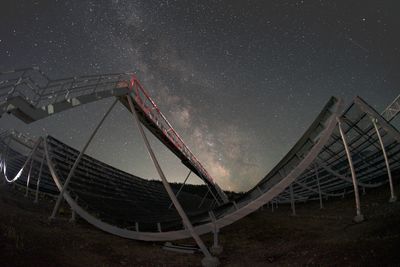
Now, new work has reported the signal from almost 8 billion light-years away. Researchers used the radio observatory CHIME (Canadian Hydrogen Intensity Mapping Experiment) to try and capture this faint emission.
“Hydrogen is the most common element in the universe and the raw material from which stars form,” co-author Dr. Arnab Chakraborty, postdoctoral fellow at the University of Toronto, said in a statement. “Its faint radio emission acts like a cosmic tracer, revealing how matter is distributed across space.”
Matter in the universe is distributed in the cosmic web. Astronomers assume that 80 percent of this matter is a hypothetical substance known as dark matter, which does not interact with light. The rest is the stuff that makes up everything else, from wombats to galaxies.
Mapping the distribution of neutral hydrogen gives us a way to probe all the rest of the stuff that we can't see.
“Our data indicate that roughly two per cent of the hydrogen in the universe was in neutral atomic form at this time, broadly consistent with other measurements,” added co-author Dr. Shabbir Shaikh, postdoctoral fellow at Arizona State University.
“By measuring how that hydrogen is distributed and clustered, CHIME gives us a new way to test our understanding of how galaxies form and evolve.”
Much more to come
The team has used only a small fraction of the seven years' worth of data collected so far by CHIME. They aim to push the analysis further back into the past of the universe, which means – due to the finiteness of the speed of light – back in time.
They want to map this neutral hydrogen to around 10 billion years ago.
“We worked very hard to convince ourselves that this wasn’t a false alarm,” said Dr. Chakraborty. “After all the tests, the signal remained. That gave us confidence we were seeing real hydrogen from the distant universe.”
The work has further-reaching potential. The neutral hydrogen signal can also be used to probe dark energy, the hypothetical feature responsible for the accelerating expansion of the universe.
The two leading methods to measure the expansion rate continue inexplicably to disagree on the true value. This would be an independent way to check for issues with both of them and maybe solve the so-called Hubble Tension once and for all.
“This is a completely new technique for probing the cosmos, delivered by an instrument that was conceived, built and funded by Canadians,” said co-author Dr. Mark Halpern, professor in the UBC department of physics and astronomy and CHIME principal investigator.
“It’s a bold new step in the global cosmology program and a Canadian success story.”
A paper describing the results is published in The Astrophysical Journal Letters.