Space and Physics
 PUBLISHED



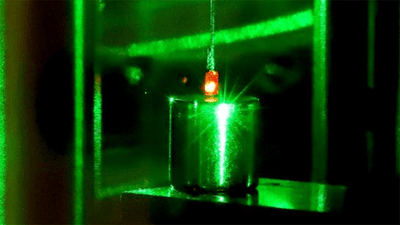


Researchers from the Okinawa Institute of Science and Technology (OIST) say they've taken a step towards "Schrödinger’s cat in real life" after moving a centimeter-long object using a quantum effect. As well as being pretty neat in its own right, the work could help future experiments looking into the boundaries between quantum mechanics and classical physics.
As has often been said over the decades, classical physics gives an unreasonably good description of gravity and macro-scale objects, while quantum physics gives us an unreasonably good description of what's going on at tiny atomic and subatomic scales.
The problem is that these two frameworks don't play well together and the boundaries between them are incredibly difficult to study, a problem that has repeatedly defied physicists' quest to produce a unifying theory of physics. It's been more than a century since the birth of quantum mechanics, and we still don't know whether gravity is quantum or not.
One problem for physicists (thankfully not for the rest of us) is that gravity is so gosh-darn weak at the scales where quantum mechanics reigns, while demonstrating quantum effects at scales affected by gravity is particularly difficult as it becomes more troublesome to isolate the object from environmental factors like heat and vibration, which tend to cause fragile quantum states to collapse.
“To test the quantum nature of gravity, we ultimately need to put objects with large enough masses into quantum superposition. And these objects need to be levitated in a vacuum to minimize the influence of environmental noise,” first author Anshuman Nayak, PhD student at the Okinawa Institute of Science and Technology's Quantum Machines Unit, explained in a statement.
“The typical approach has been to start with extremely small, levitated objects and gradually increase their mass until the effects of gravity become relevant. But levitating macroscale objects using conventional techniques, such as optical traps, has proven extremely challenging."
"That’s why we’re in the opposite camp — going from large to small. Just as diamagnetic levitation can lift maglev trains, it can also be used to levitate centimeter-wide objects holding diamonds, where the effect of gravity can be extremely strong, but quantum effects have not been observed.”
Defective diamonds have their uses
For their latest experiment, the team worked with an impure diamond, some graphite, and our old friend the magnet. The researchers used a 128-milligram diamond filled with billions of nitrogen-vacancy (NV) centers, where one nitrogen atom replaces a carbon atom in the diamond's atomic structure and next to it is a vacancy where a carbon atom is missing.
These defects are actually pretty useful, allowing scientists, or anyone with a laser, really, to play around in a quantum fashion. "In its negatively charged state, it exhibits a spin-1 electronic ground state that can be polarised, manipulated and read out using optical and microwave techniques at ambient conditions," according to Nature Index.
What that means, in simpler terms, is these defects are like tiny, controllable magnets. But because these magnets are switched on and off via a quantum phenomenon called a "spin state," they provide a perfect way to measure the effect of quantum mechanics in the world of classical physics.
The team was able to track with incredible accuracy how a macro-scale object – in this case a 1-centimeter diamond – moved in response to a magnet both when the laser was on and when it was off. They found that simply by changing the contribution from quantum spin, the distance moved by the diamond could be increased to the order of about 100 nanometers.
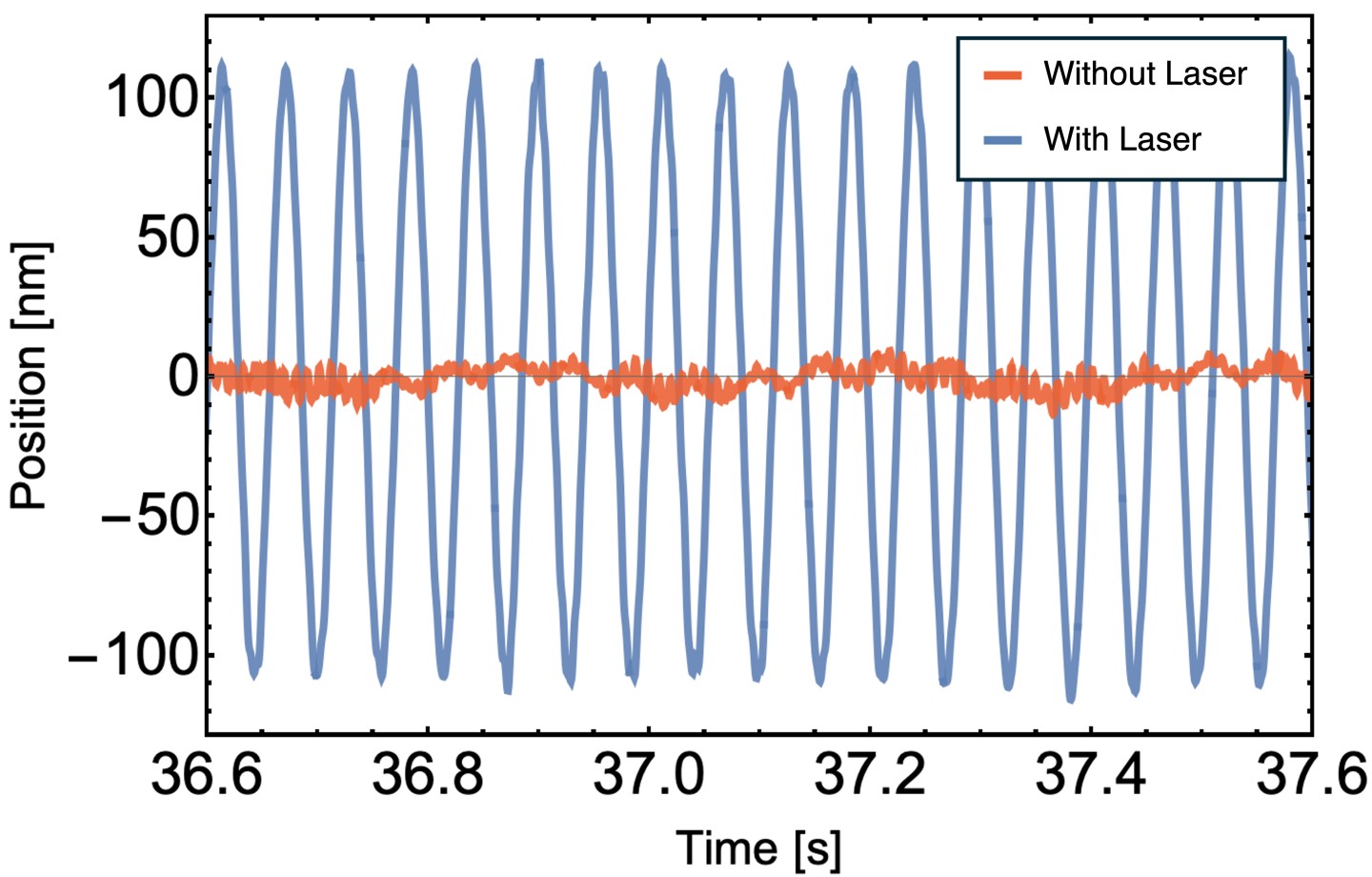
“There have been many efforts to test whether quantum mechanics holds for anything larger than a few tens of nanometers, so far without success," Professor Jason Twamley of the OIST Quantum Machines Unit added. "Now, we have observed a classical mechanical response to a quantum force on an object that is eight to nine orders of magnitude more massive than the current state-of-the-art spin-mechanical experiments.”
The team hasn't demonstrated Schrödinger's cat, in which the fate of a macroscopic cat is linked to the observed or not observed outcome of quantum events, and a cat remains alive and dead at the same time until that outcome is observed, but it is an impressive and neat demonstration of a quantum effect having macroscopic consequences.
“We’ve shown a large classical response from a small quantum effect. It’s no longer a question of whether such technology is possible, but of how we can refine experimental conditions to achieve quantum superposition within the regime of Einstein’s general relativity," Twamley added.
"And on the way, we’re developing a new class of extremely precise sensors. We’re pushing the bar from nanometers to centimeters. All we need is another order of magnitude, and we can finally observe Schrödinger’s cat in real life.”
The study is published in Science Advances.