Space and Physics
 PUBLISHED




What you'll discover in this article
- Three new galaxies, belonging to the hypothetical class of backsplash galaxies, have been discovered.
- Julian Shapiro, a freshman at UC Berkeley, worked on this while still in high school.
- “Backsplash galaxies have been long-predicted in simulations, but no definitive observed examples have been confirmed yet,” Shapiro told IFLScience.
Most galaxies in the universe are small. Of these dwarf galaxies, some exist at the edge of larger objects while others are just by themselves. The former tend to be gas-poor with little star formation. The latter are a lot more active.
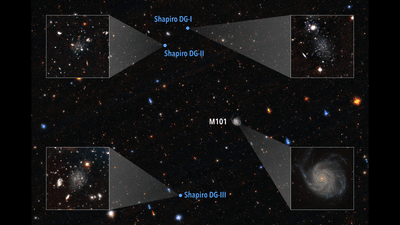
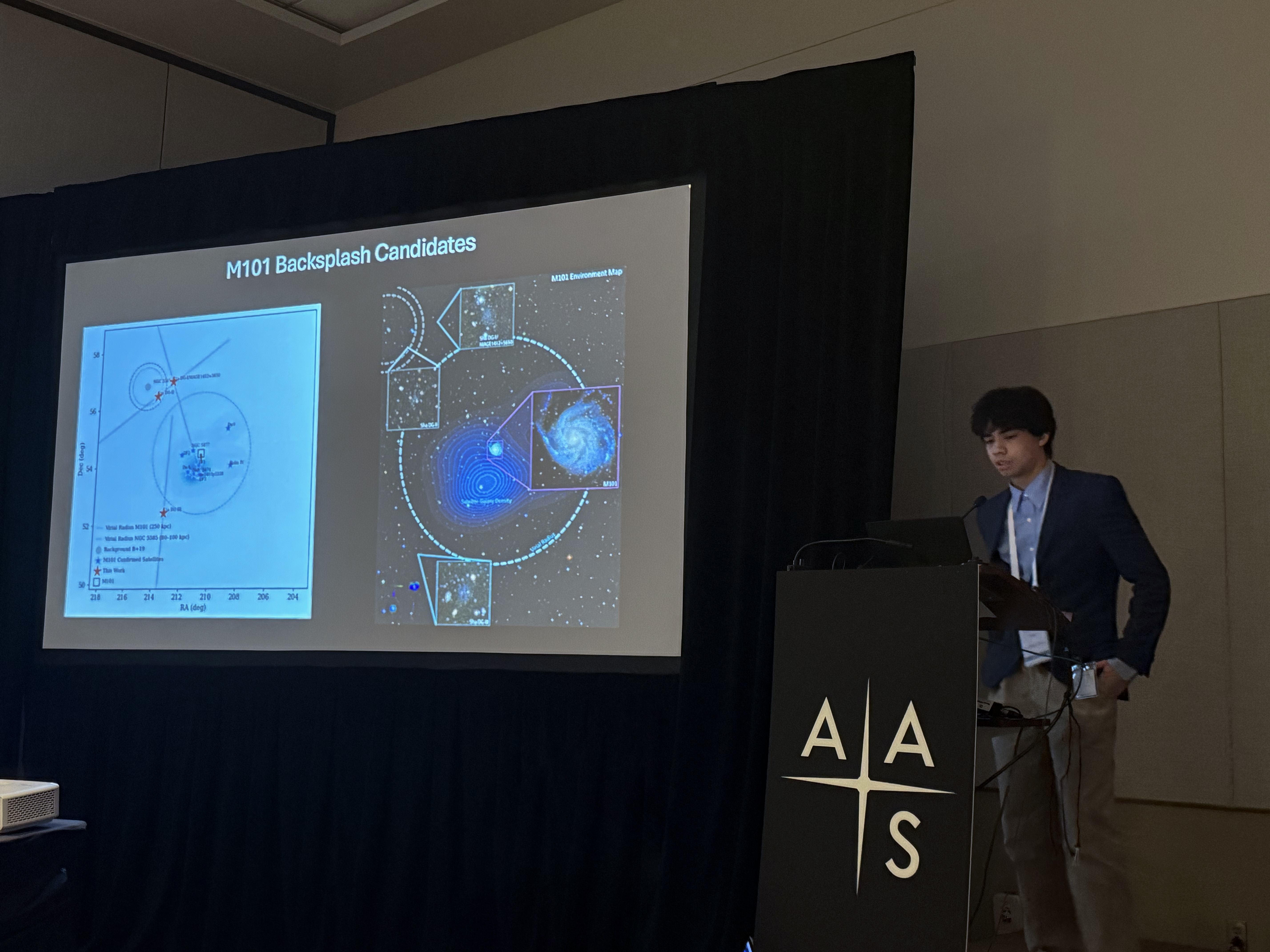
But finding three isolated galaxies that are gas-poor with limited star formation was certainly a surprise, and discoverer Julian Shapiro argues that they might be the first "resolved" backsplash galaxies.
He conducted the research while he was still in high school.
“I discovered three isolated dwarf galaxies in our local universe that are not forming new stars. Galaxies like this are extremely rare and an astrophysical puzzle, as isolated dwarf galaxies lack large neighbors to remove their star-forming gas,” Shapiro told IFLScience.
“My work proposes that the three objects may be 'backsplash' galaxies, having once passed by the Pinwheel Galaxy (M101) where they were stripped of their gas, before being flung out.”
Backsplash galaxies have been long-predicted in simulations, but no definitive observed examples have been confirmed yet.
Julian Shapiro
The three galaxies are known as Shapiro Dwarf Galaxies I, II, and III. They are located between 15 and 25 million light-years away. There is a possibility that Shapiro Dwarf Galaxy II is actually a satellite of another spiral galaxy, NGC 5585.
Shapiro used simulations to predict likely locations for the existence of the backsplash galaxies in the nearby universe. He then used archival observations to spot the most promising candidates.
The confirmation of their true nature will require follow-up studies, but the work is very exciting. Backsplash galaxies' plentiful existence is one of the predictions of the standard model of cosmology, also known as Lambda-CDM.
“Backsplash galaxies have been long-predicted in simulations, but no definitive observed examples have been confirmed yet. This makes the discovery of these three candidates an important test of consistency between our observations and theory from Lambda-CDM expectations,” Shapiro told IFLScience.
Shapiro has proposed a method for predicting the frequency of these galaxies. As he continues his studies, he’s gotten involved with the work to answer some big questions in astronomy without forgetting about the faint galaxies that are still out there.
“At Berkeley, I have joined Alex Filippenko's group to research the Hubble tension, the 'crisis in cosmology'. I am also continuing my work with galaxy evolution as the principal investigator of a new 100+ hour deep imaging program of low surface brightness galaxies," Shapiro revealed.
The study is published in The Astrophysical Journal.